Name: Shred of Redemption
Year of Release: 2025
Player Count: 1
Playing Time: 10 – 20 Minutes
Designer: Artem Safarov
Publisher: Best With 1 Games
Primary Mechanisms: Bag-Building, Dice Manipulation, Solo
Weight (According to BGG.com): 2.00
Overview
Whenever I share my passion for board games with people outside of the hobby, it is always surprising to them when they learn that all sorts of games come with solo variants and yes, some games are even solo only! This makes sense if your concept of board games stops at classics such as Sorry, Parcheesi, or Monopoly as none of those would seem very much fun from a one-player perspective. But with the wide landscape of strategy games out there, it is fairly common for designers to produce a solo aimed variant that actually works and is *gasp* fun!
I don’t have a regular gaming group, and my spouse is over learning new games every month, so I’ve been exclusively purchasing games that are solo only or, at least, include a solo variant. This led me to find the Solo Game of the Month series on Gamefound. I quickly backed Shred of Redemption and then waited for it to be fulfilled. After quite a long wait, there were all sorts of postage issues, the publisher finally got it all worked out and my copy arrived. Read on to see what Shred of Redemption brings to your table!
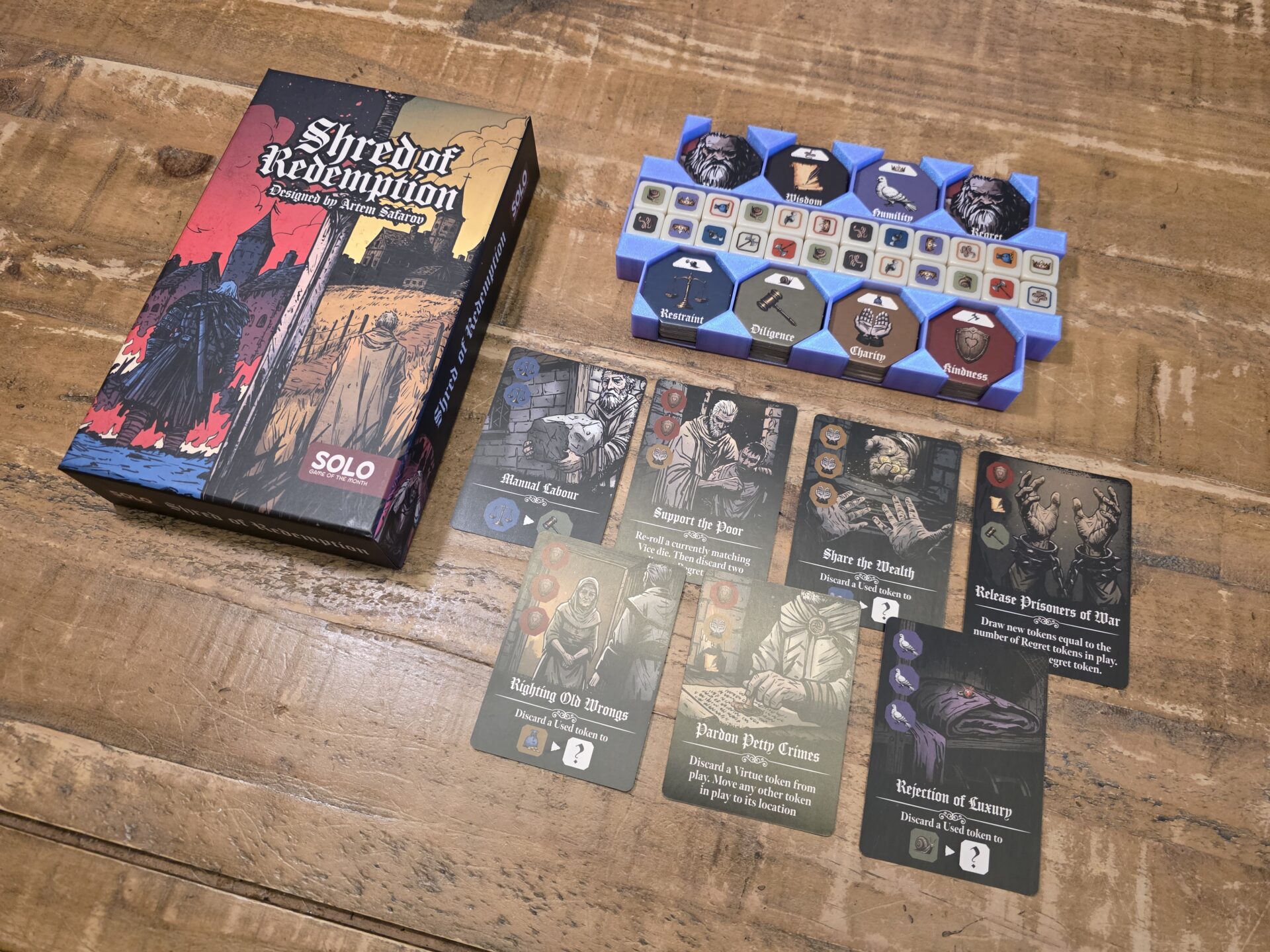
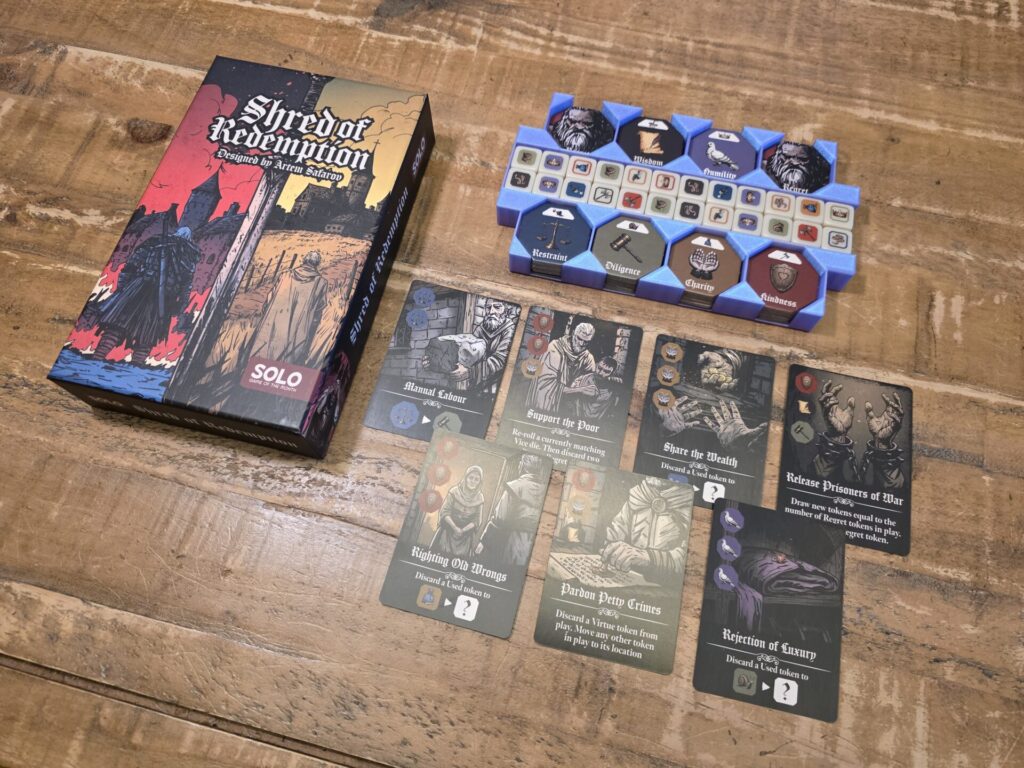
Note: This review is going to contain pictures that show the game being set up with a 3D-printed organizer that DOES NOT come with the game. If you are interested in this organizer, please visit HERE and thank you to Ray_Boniface for designing it.
Rulebook & Components
Shred of Redemption can be played in less than 20 minutes so players shouldn’t expect a long-winded rulebook. The information it conveys will get a player up-and-running quickly, but I have a few problems with how the information is presented. The page backgrounds are black and all the colors in the game are of very dark hues, causing a lot of the highlighted words (especially the dark blues) to get lost amongst the background. Fortunately, many of the highlighted words are in a yellow-ish color that stands out but good luck quickly reading anything in the blue, green, or red colors.
Secondly, with a rulebook this short, it would have been nice to include a page that gave some more clarification on some of the Redemption Cards. While playing, I’ve had to visit the forum on BGG to understand exactly how some of the card actions work. While the designer seems active and contributes answers on the forum, I’m a believer that players shouldn’t need an auxiliary source just to understand how to play the game.
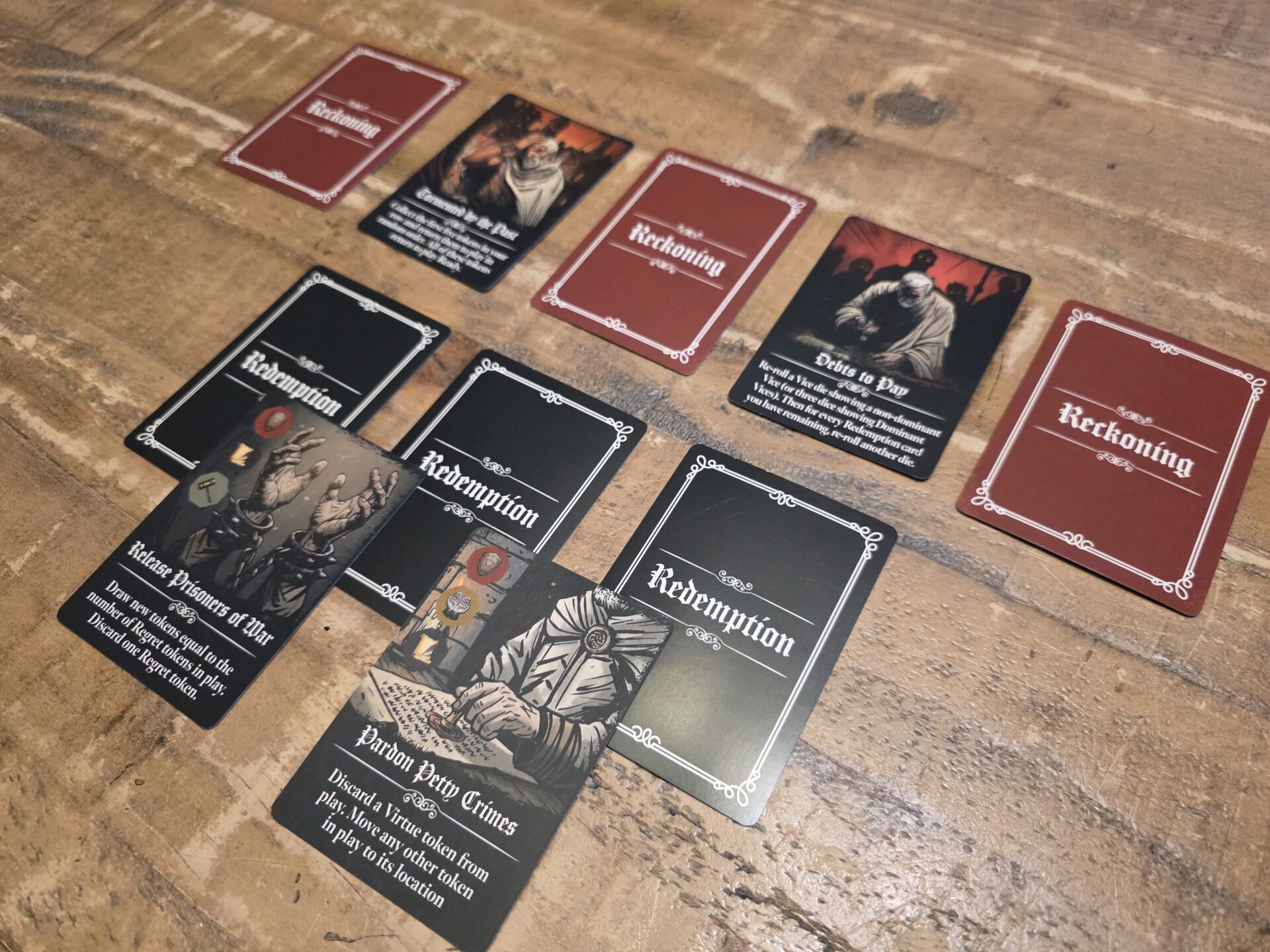
The components are a mixture of cards, dice, tokens, and a bag. The main cards are split into Redemption and Reckoning Cards, both including impressive artwork by Cole Munro-Chitty that pulls the player into the feeling of atoning for past sins. The game also includes 24 Vice Dice, four of each of the six Vices represented in the game: Vanity, Wrath, Greed, Envy, Debauchery, and Sloth. The dice have three sides dedicated to a single Dominant Vice and then three Non-Dominant Vice sides, each displaying a different Vice. You’ll only ever be using five of these dice but the inclusion of 24 was important to ensure the randomness from game to game.
Players will also get a stack of tokens, 54 in total. 42 of these are Virtue Tokens and will be split into six groups of seven tokens each. Each group represents one of the game’s Virtues, the mechanism in which players vanquish their Vices. The last 12 tokens are emblazoned with the character’s younger face, full of self-doubt and loathing, and are called the Regret Tokens. You’ll come to learn more about these in the gameplay portion of the overview.
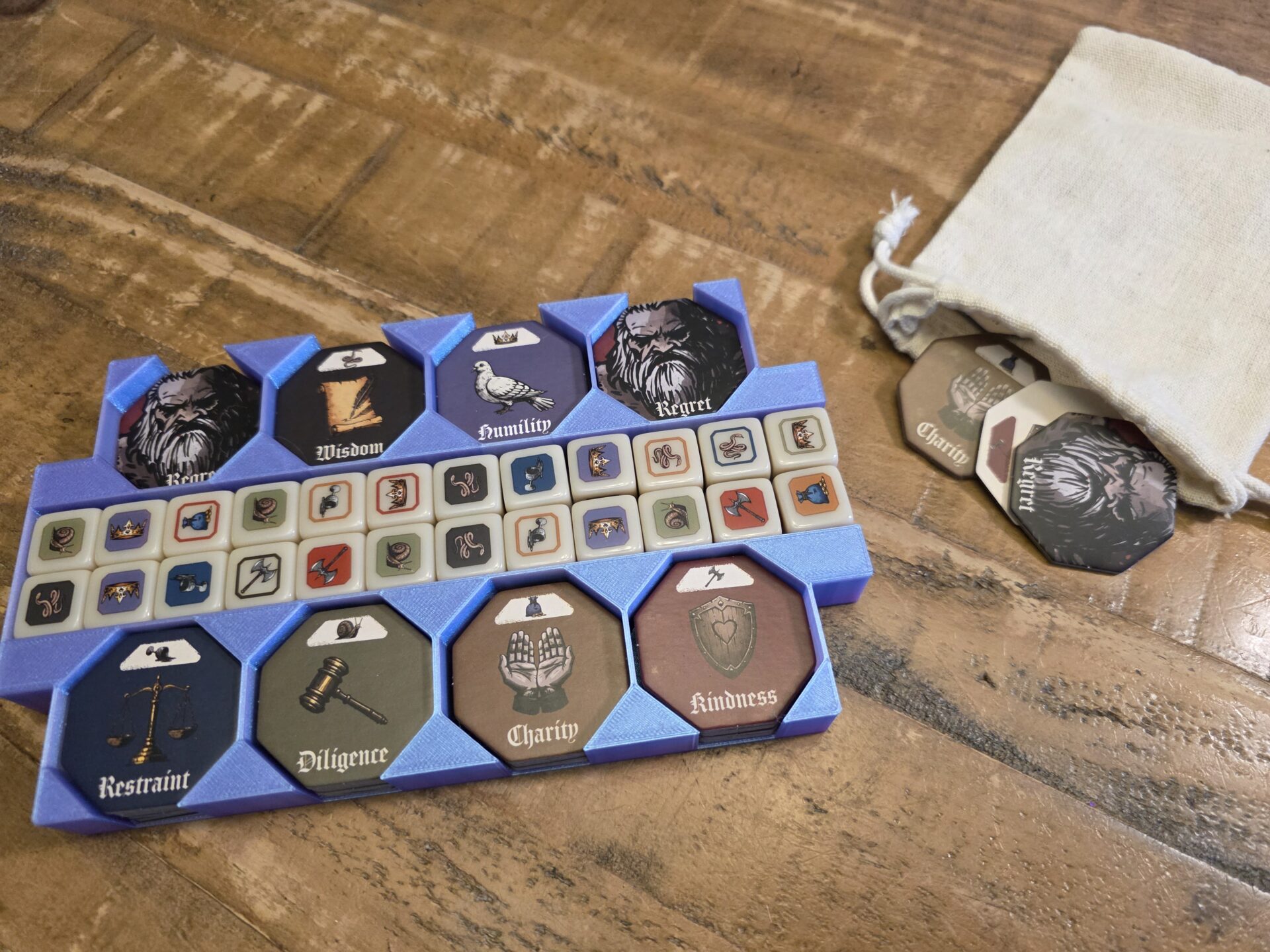
Altogether, the components are nice and simple, keeping the footprint small which is nice. My one gripe is the Canvas Bag. It’s just too small for the intended use, which is to dump upwards of 30 tokens into and then somehow “shuffle” them around and draw from during gameplay. Reading comments around the net, I am not the only person that feels this way. I kept the bag to use with the dice for the setup portion of the game but quickly grabbed another bag (from Quacks of Quedlinburg) which I find to be much easier to use.
Gameplay
Setting up Shred of Redemption is a painless affair, especially since some of the preparation is baked into the first phase of gameplay. The player needs to separate the tokens into stacks, shuffle the Redemption and Reckoning Cards and place them into their own piles, dump all 24 Vice Dice into the draw bag, separate the Vice Cards into separate stacks, and lay out the Virtue Reference Cards in a row. If you have access to a 3D printer, I can’t recommend this custom organizer enough. I have no connection with this designer, but I printed this the day I got the game in the mail, and it has made setup and tear down a breeze.
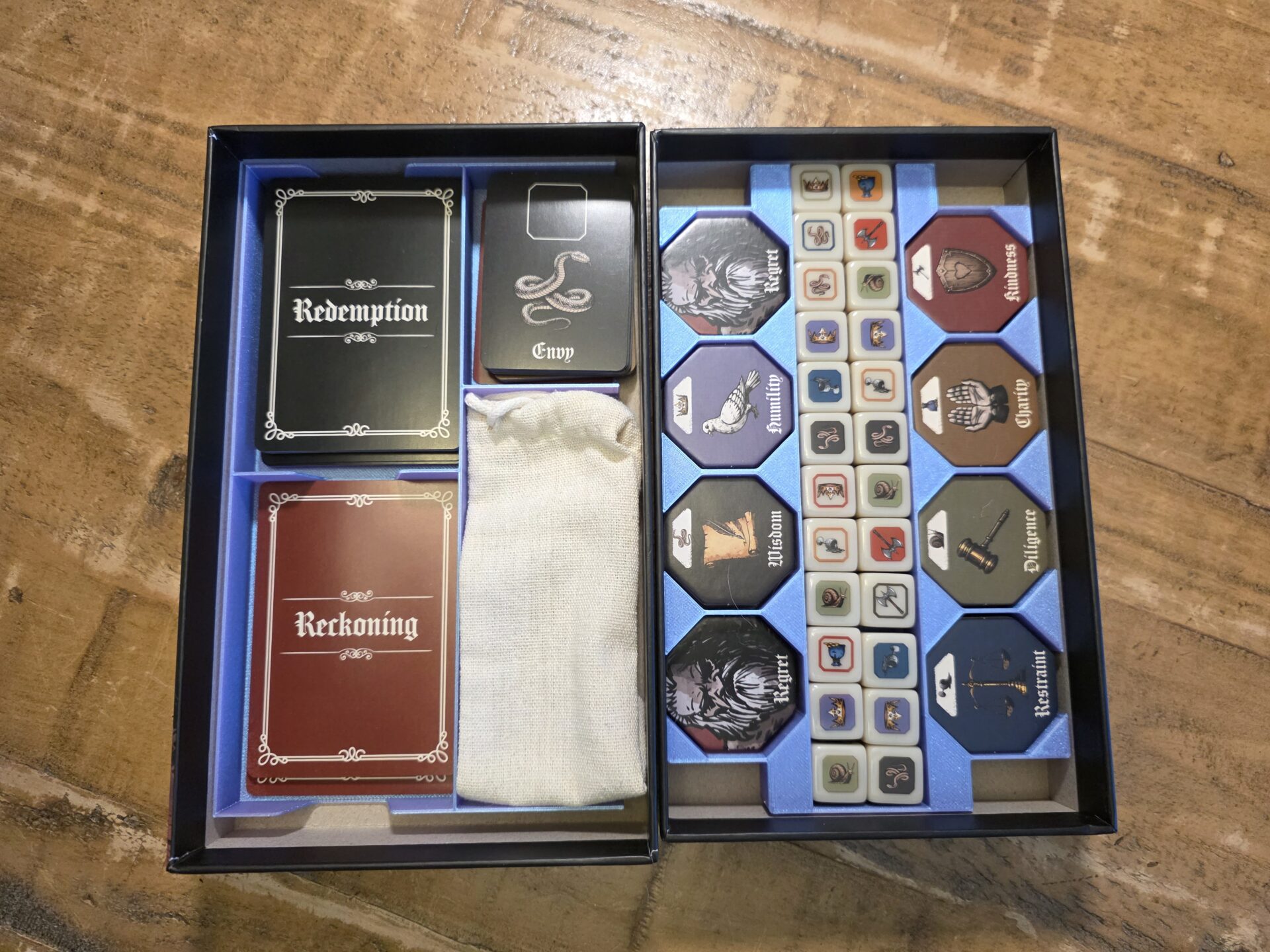
Playing a game of Shred of Redemption happens over the course of three phases so let’s take a look at each one in detail.
Reflection Phase – Look back on your life to determine what your main Vices were, and what actions you might take to redeem yourself from them.
The first phase, the Reflection Phase, is going to be all about building your bag and gaining your Redemption Cards. The player will first draw one Vice Die from the bag and place it in front of them. Players don’t need to roll this die yet, but they should take note of the Vices, especially the Dominant Vice, printed on the sides. The player will then draw two Redemption Cards from the deck, choosing one to keep for their hand and discarding the other. The player will continue to do this for a total of five times so that there are five dice and five cards in front of them, both in rows from left to right.
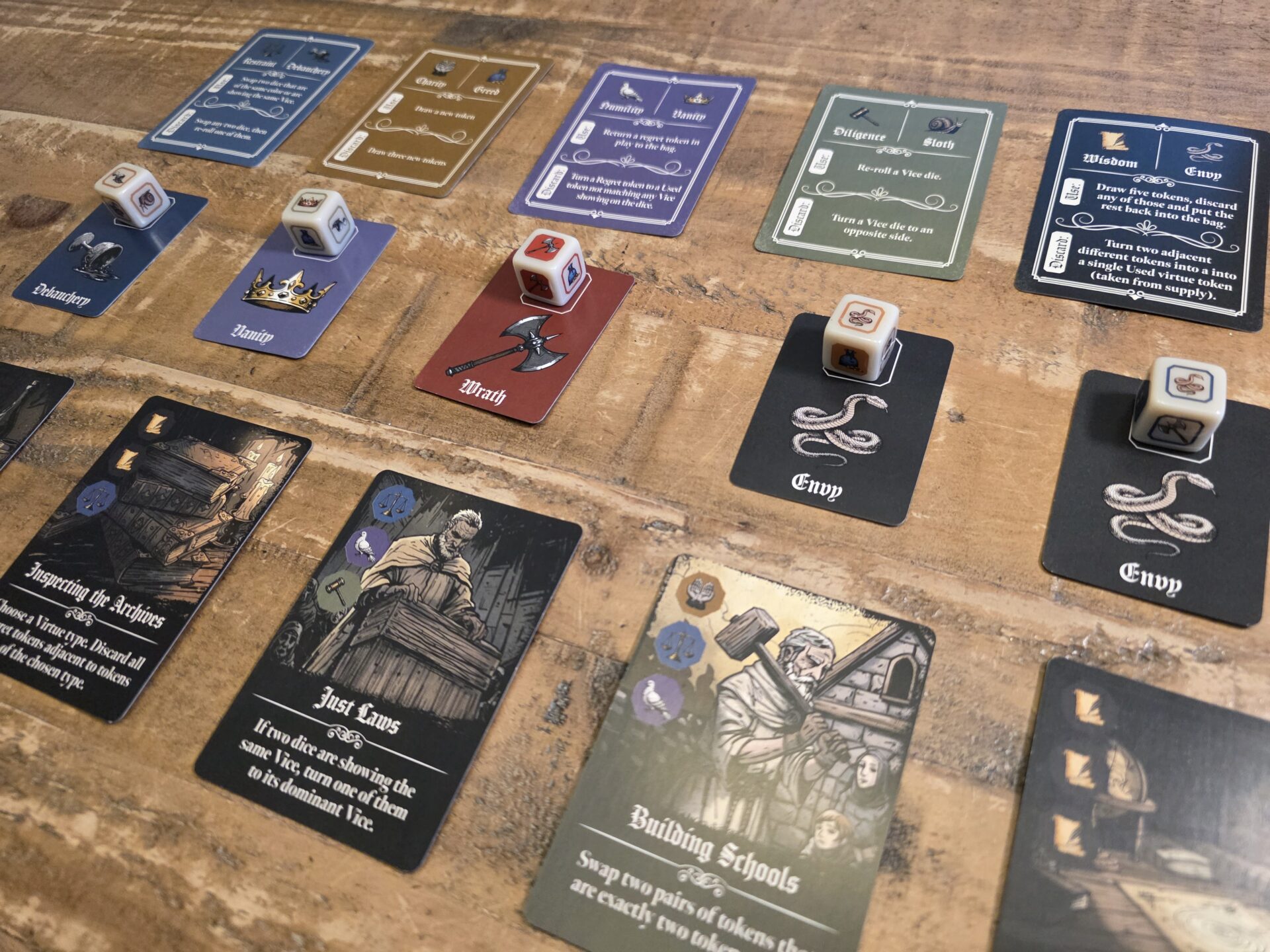
So, how do players decide which Redemption Cards to keep? Each card is printed with a two pieces of information, with the top left icons being key to the decision-making process. See, this is where the Virtue Icons will be printed and will determine which Virtue Tokens are placed into the player’s bag. Players are going to want to make sure that they are collecting tokens that are going to pair with that token’s matching Vice listed on the die. Of course, the player hasn’t rolled the dice yet so they don’t have a complete picture of what they will be facing. Remember that the Dominant Vice covers three of the six sides of each dice, giving a higher probability for those Vices compared to the Non-Dominant ones so that can be useful hint for players.
Along with the Virtue Icons, Redemption Cards also have an action listed at the bottom. When the card is played in the second phase, the player gets to activate this action once and then discards the card. While these actions are important and can be a game changer in certain situations, I find it to be more important to focus on getting the correct tokens into your bag because without them, it’s going to be almost impossible to win. But if a player has two cards with similar icons, the action text is a great tiebreaker for choosing.
Once the cards have been chosen, the player needs to build their bag. First, they will put in six Regret Tokens from the supply. Next, they’ll place one of each of the Virtue Tokens in. Lastly, they’ll place tokens equal to the Virtue Icons printed on their five selected Redemption Cards and the building of the bag is complete.
Lastly, players need to roll each die to find out the specific Vice they need to rid themselves of. Once a die is rolled, players can place it on top of the matching Vice Cards; smaller sized cards that help distinguish the dice for players. After this step is completed, the player will draw tokens from their bag, placing one below each of the Vice Cards, until they unveil five Virtue Tokens. This means that if they pull a Regret Token, it still goes underneath the next card, but the player will pull an additional token to place in the row, extending past the end of the Vices row. After the tokens are laid out, with five Virtue Tokens being essential, the second phase is ready to start.
Redemption Phase – Take actions using your Virtues and Redemption Cards to try and line your Virtues up with your past Vices.
The second phase is going to be where the bulk of the action takes place, giving players a chance to right those wrongs in their earlier life. There are two goals that a player must satisfy in this phase to move on to the third, and final phase. One goal is to remove all of the Regret Tokens, if any, from the Token Row that was formed during the Reflection Phase. Second, the player needs to move the corresponding Virtue Token underneath each of the five revealed Vice Dice until all five slots match. I covered the list of Vices earlier, but the matching Virtues are Humility, Kindness, Charity, Wisdom, Restraint, and Diligence.
The player is going to utilize two different methods to manipulate the tokens and dice to achieve these goals. The primary method is going to be to use the Virtue Tokens themselves. When placed in the row, Virtue Tokens are turned to their Ready side, denoted by a full-colored background. The player can choose to flip a token over to the Used side (denoted by a white background) or can discard the token from the row altogether. Each Virtue Token acts differently while also giving separate actions for using the tokens compared to discarding them.
An example of this is flipping a Charity Token to the Used side allows a player to draw one token from the bag and place it at the end of the Token Row. Alternatively, if discarding the Charity Token from the row, players are allowed to add three random tokens from the bag to the end of the row. If a token is already on the Used side, the player can choose to use it again, but it will be discarded from the row. This allows the player to get two Use Actions out of a token, or one Use Action and one Discard Action, or simply discard it from the Ready side to get one Discard Action. The token actions all vary but can be boiled down to adding tokens to the row, swapping tokens, discarding Regret Tokens, or manipulating the dice by either re-rolling them or swapping the placement of them.
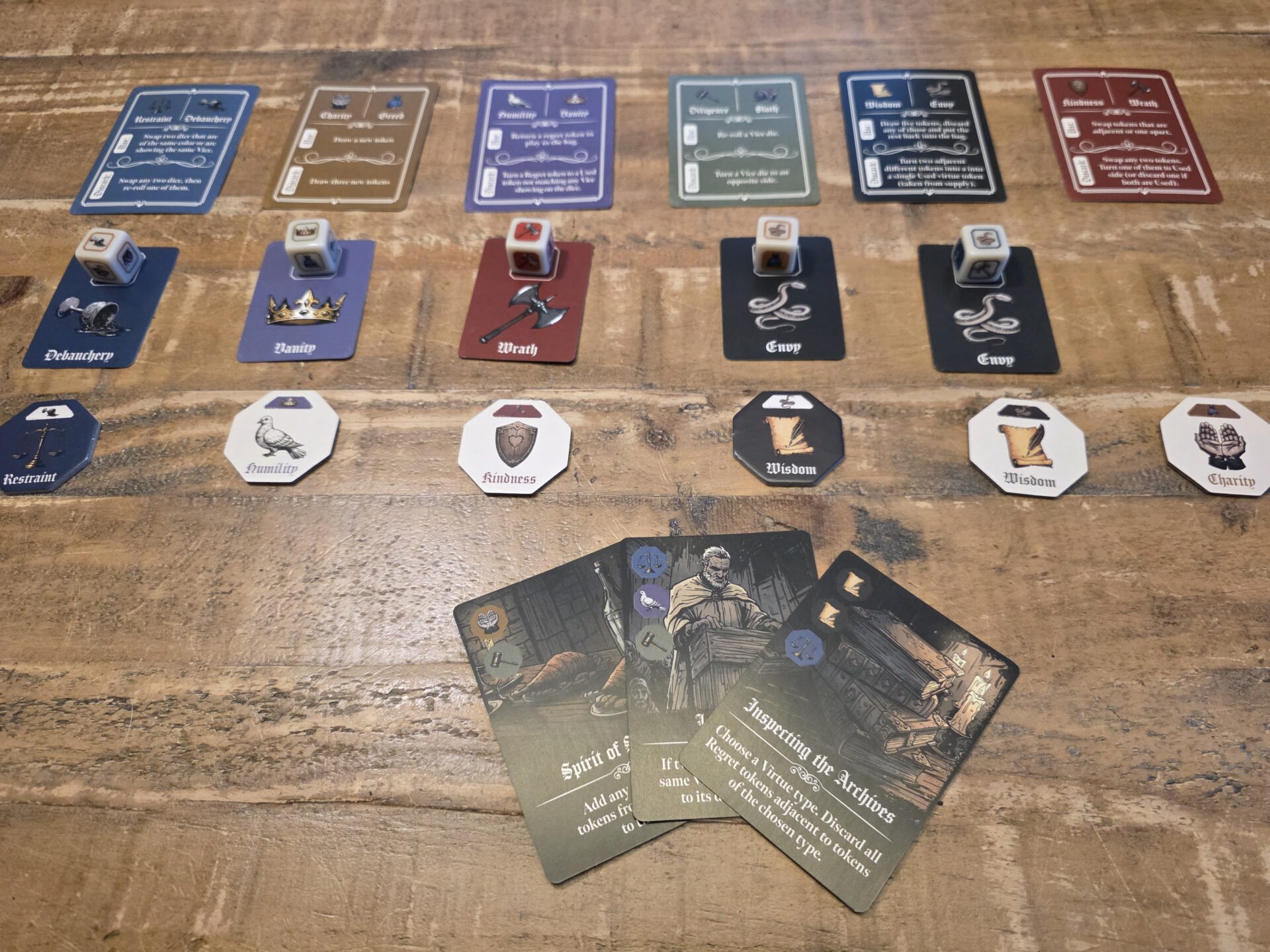
Occasionally, the tokens in the row don’t allow the player to make much progress, and that is when the player needs to turn to their five Redemption Cards for help. Each card can be discarded to trigger the action text listed on the card. If the action on a card isn’t helpful, the player can instead discard it to add a single Regret Token from the supply to the Token Bag, then draw two random tokens to place at the end of the row. While adding Regret Tokens is never helpful, adding two more tokens to the row can keep the player alive for a little while longer. Each card is unique in its action, and the player will need to harness these actions, in conjunction with the Virtue Tokens, to succeed at the Redemption Phase. If the player runs out of actions and has yet to remove all Regret Tokens and line up the correct Vices and Virtues, the game is over.
But if you manage to succeed at both goals, move on to the final phase, the Reckoning Phase.
Reckoning Phase – One last obstacle arises, posing a final threat to your redemption.
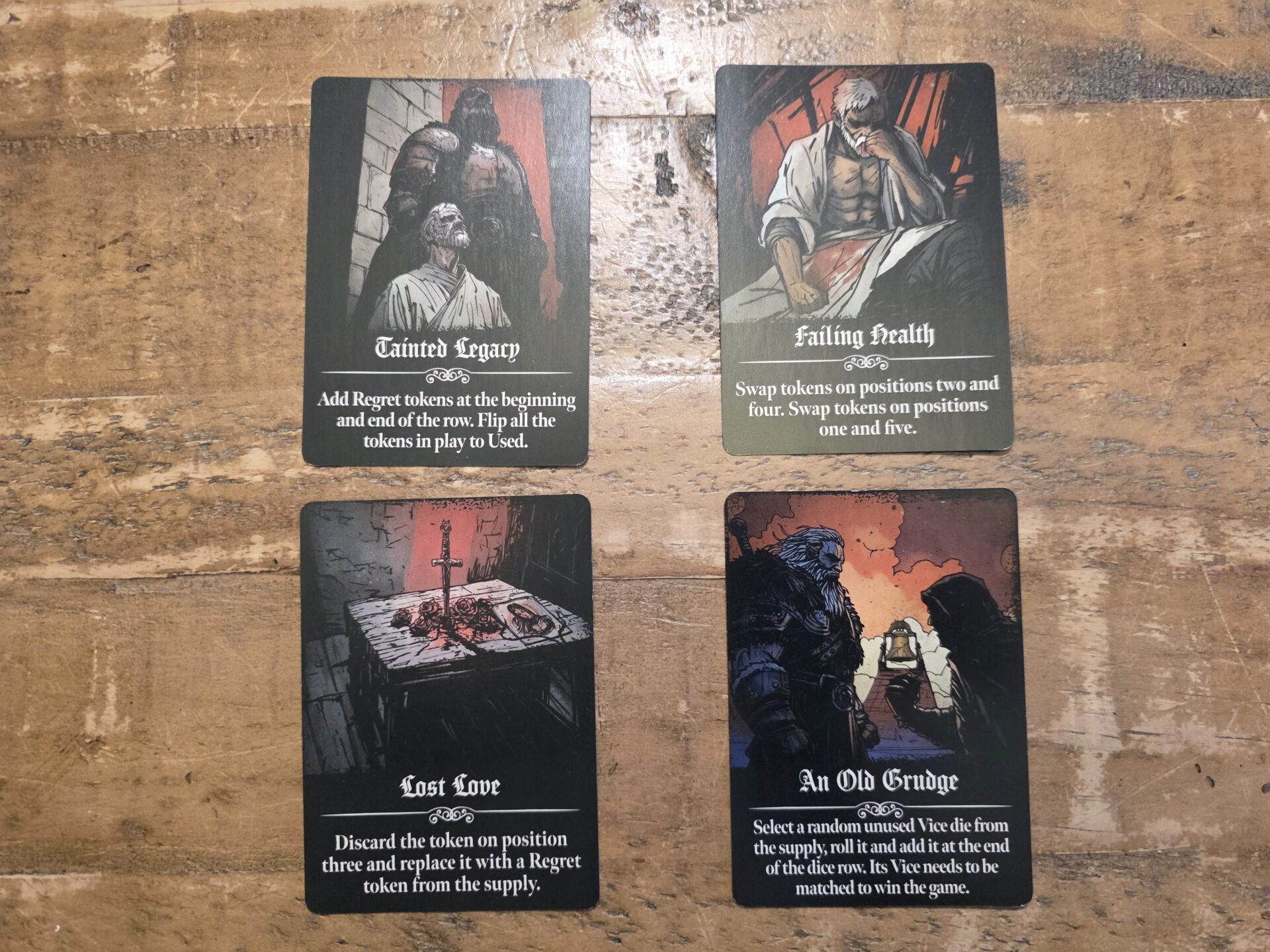
In the Reckoning Phase, the player will draw one of the red Reckoning Cards and apply its effect to the current layout. These cards can superbly wreck the current board status, causing complete chaos for the player. Two examples include the card Failing Health which says, “swap tokens on positions two and four. Swap tokens on positions one and five” and the card Tainted Legacy that states “add Regret Tokens at the beginning and end of the row. Flip all the tokens in play to Used.”
Once the effect has been applied, play continues as usual, with the player trying to get the board back to a winning state (no Regret Tokens and Vices and Virtues aligned). If there were any Redemption Cards left over from the Redemption Phase, the player can continue to use these in the Reckoning Phase. Again, if the player runs out of actions before bringing the board to the winning condition, the player loses the game.
Conclusion
Shred of Redemption has been a really fun solo puzzle experience. I like the fact that it has a nice mixture of randomness (dice rolling and tile drawing) but gives the player plenty of agency (building the bag and manipulating the Vice Dice). I do wish the Reckoning Phase had more to differentiate it from the Redemption Phase. In my experience so far, I can overcome the Redemption Phase around 90% of the time but lose in the Reckoning Phase at least half of the time. This can all feel a little anti-climactic and I think the game would have been better served with a bigger finale but nevertheless, the majority of the game is entertaining and never overstays it’s welcome.
Rating
Ratings are based on 5 main criteria: rulebook, setup, components, art & graphic design, and gameplay. The first 4 criteria are rated 1 to 5 and the gameplay is rated 1 to 10. These scores culminate in an “overall satisfaction” score that is rated from 1 to 10. If the reviewed game has both a solo and multiplayer mode, I have assigned scores separately to give context to which mode we enjoy more.

Rulebook – 3
Setup – 4
Components – 3.5
Art/Graphic Design – 4
Gameplay (Solo) – 7
Overall Satisfaction (Solo)
Pros:
- Unique melding of bag building, dice manipulation, and card playing.
- Quick but crunchy
- Great artwork
Cons:
- The canvas bag that comes with the game is worthless.
- Unsatisfactory final phase
Links