Name: SETI – Search for Extraterrestrial Intelligence
Year of Release: 2024
Player Count: 1 – 4
Playing Time: 40 – 160 Minutes
Designer: Tomáš Holek
Publisher: Czech Games Edition (CGE)
Primary Mechanisms: Area Majority, Income, Multi-Use Cards, End Game Bonuses
Weight (According to BGG.com): 3.83
Overview
Sometimes you see a game and you just know you’ll enjoy it. Maybe it’s the mechanisms, maybe it’s the artwork, but something about the game immediately calls your name. That’s how SETI: Search for Extraterrestrial Intelligence was for me. The strange thing is, it still took me until 2026 to purchase the game. That $70 price tag plus the possibility of the game not meeting my lofty goals, kept it at arm’s length for me. I finally convinced myself earlier this year that I just needed to go for it, or I’d always wonder if this was going to be one that I shouldn’t have missed. I’m happy to report that it met all of my expectations and I’m actually pretty obsessed with it at the moment.
Read on to see an overview of how to play and why I like this game so much. Unlike most of my written articles, I’m not going to discuss setup here. Head over to my YouTube to see my full “How to Play” guide for setup information. Let’s blast off and explore SETI!
This review will contain pictures that include 3D-printed organizers that DO NOT come with the game. If you are interested in these, please check out the link HERE and thanks to Quiller for the fantastic design.
Components
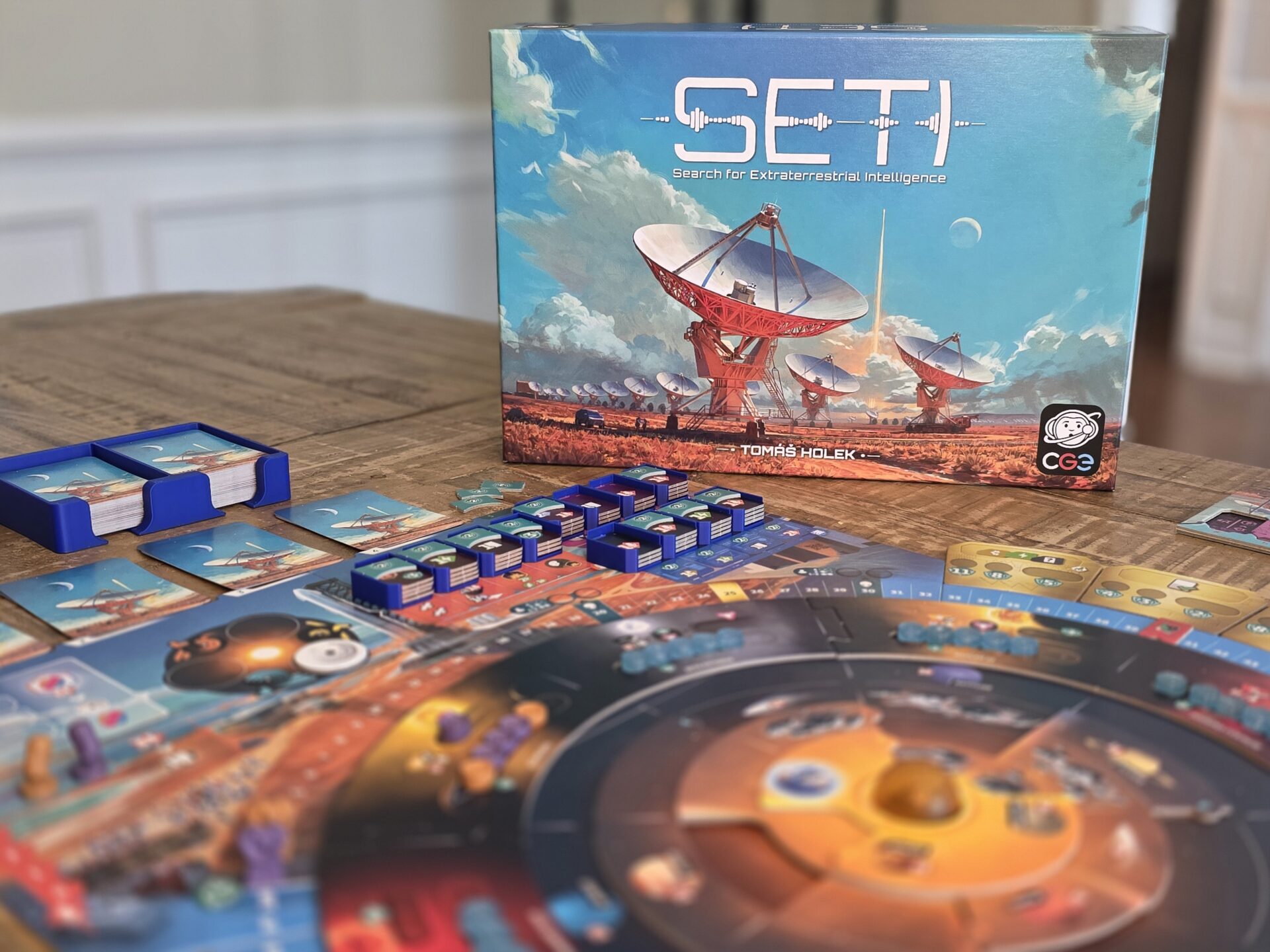
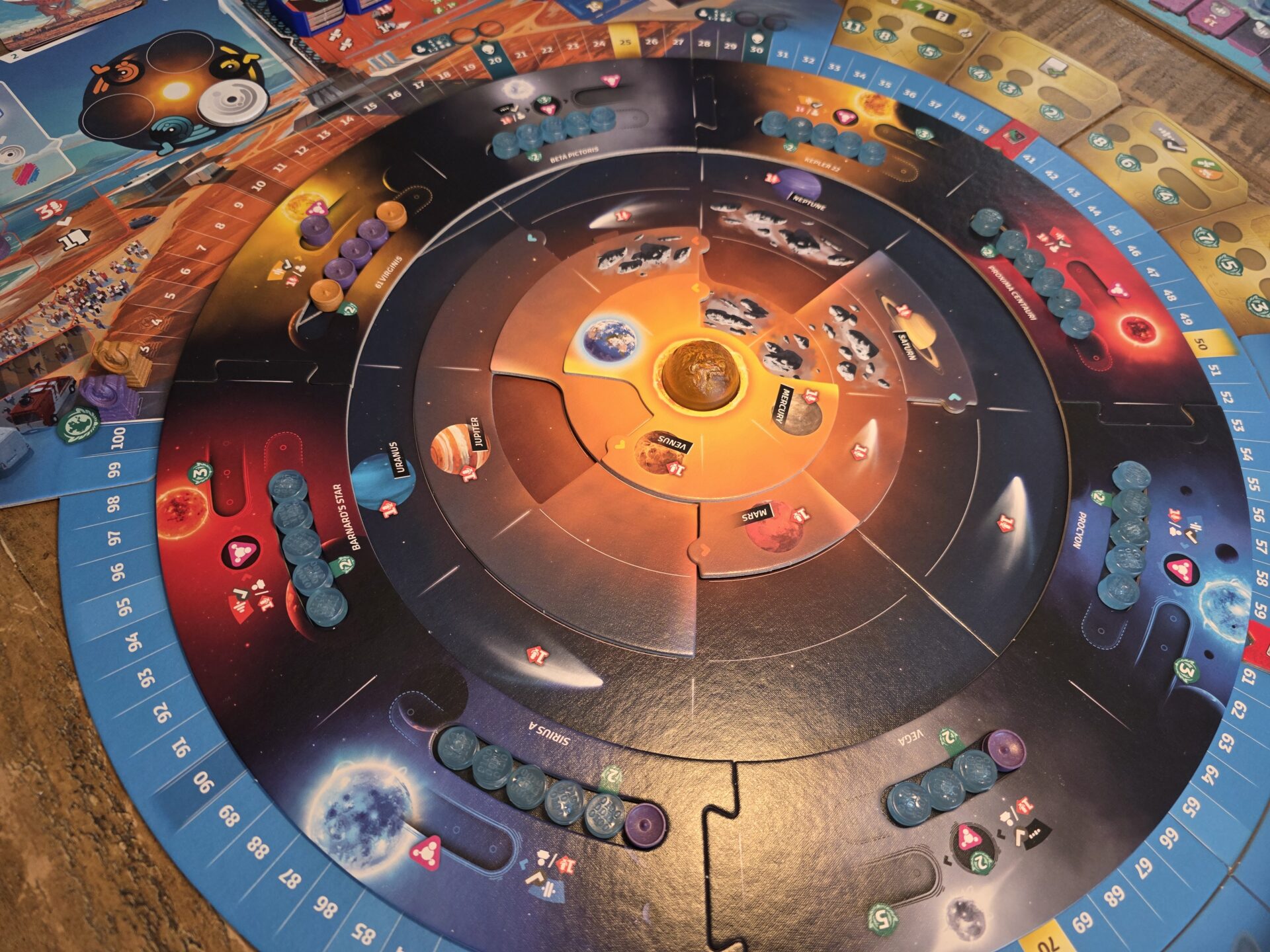
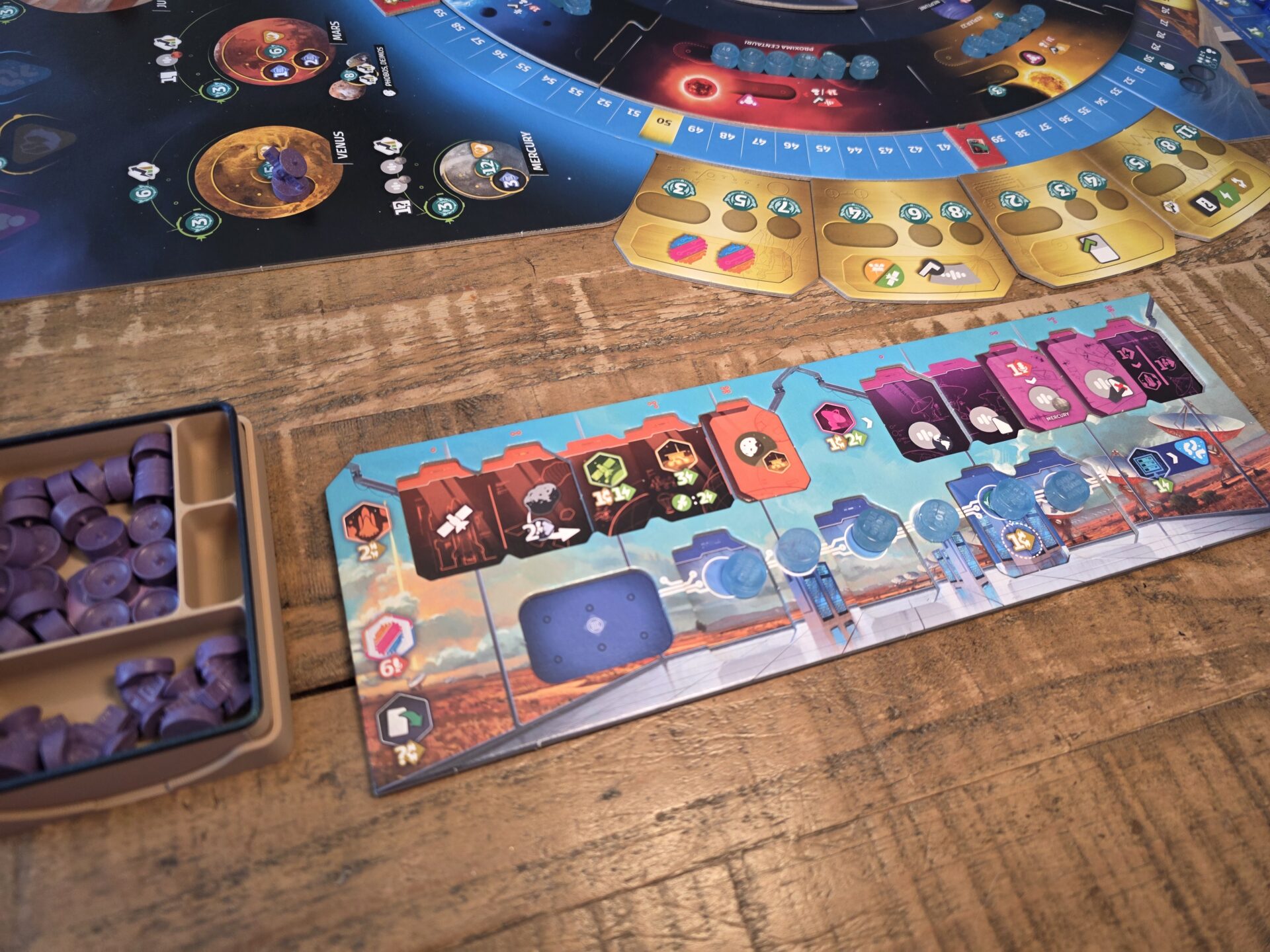
The components within SETI are first-rate, hands down. If you’ve seen any photos of this game, then you know how stunning it can look on the table. You’ve also probably noticed how much a table hog this thing is, so make sure you have adequate space! The main board is made up of three separate pieces: the Solar System Board, the Tech Board, and the Planetary Board. All three boards are gorgeously rendered and have a fantastic way of conveying a whole lot of information while not feeling cluttered. On top of the Solar System Board, players will set up the three Solar System Discs, the Sun, (an actual plastic orb that pops off the board), and the four Sector Boards. The Solar System Discs are able to orbit the Sun, which plays a central role in the game, and just looks really cool when playing. The one downside I have to this set of components is that the Sector Boards tend to slip and slide around when interacting with them.
For the individual players, they’ll receive a double-layered Player Board. This was a really nice design touch so that the player’s Tech Tiles can slot into the board and not be knocked around every time you touch the board. There is also a multitude of markers and counters in each of the player colors, the standout being the eight Probes that players will launch onto the Solar System Board. If you have access to a 3D printer, I strongly recommend you print out some of the organizers out there (the one I’m using I’ve linked in the Intro section.) Without something, players do end up with a mess of tokens laying around their player area and it can become quite disorganized fairly quickly, especially when you need real estate for the cards.
You’ll receive 138 Main Cards with the game, each one being unique. Games with these huge decks of unique cards (Ark Nova, Terraforming Mars: Ares Expedition) seem to be all the rage nowadays. Honestly, I don’t know if you need 138 of these, but they’re here, nonetheless. Much like the boards themselves, the Main Cards convey a whole heck of a lot of information, mostly with icons that you’ll need to learn. Thankfully, there are Player Aids to help you learn the icons and compared to other games of this same weight, there are actually a lot less icons to learn. While some of these cards will need to be housed in front of you, the majority of them are discarded as soon as they are played. This helps to minimize the space needed by each player so that’s nice considering the sheer amount of real estate the rest of the game takes up.
While there are other components that will play a role during the game, we’ll look at them in the Gameplay section, so let’s head there now!
Gameplay
For those readers who have played a lot of games out there, the turn structure in SETI can probably be best compared to Lost Ruins of Arnak. Essentially, each player is going to be taking only one Main Action during their turn, while also choosing to take Free Actions at any point during their turn. This will continue back and forth between players, until a player has no more actions to take, and at this point they will Pass. Players that Pass will not be able to take anymore actions during the current round. Once all players have Passed, the game continues to the next round, where all players earn Income to further their actions in the coming rounds. Rinse and repeat for five rounds, and there’s the game. There are a few wrinkles thrown in, and a few surprises, but let’s look at the Main Actions (and Free Actions where needed) first. In the following sections, Main Actions will be in all caps while Free Actions will be underlined.
LAUNCH a Probe
Taking the LAUNCH action is how a player is able to move one of those cool Probe figures from their personal supply to the Solar System Board. This action typically costs two Credits, allowing the player to place a Probe on the Earth space of the Solar System Board. By default, a player may only have a single Probe on the Solar System Board at a time, though there is a Tech Tile that can bring that number up to two Probes at a time. To leave the Earth space, players are going to want to utilize the free Move action. For every space the Probe moves, players will need to pay a single Energy token, unless the Probe leaves an Asteroid space, which costs two Energy tokens. Players should watch for cards that allow them to discard to get additional Move Actions if they want to save their Energy to be used on one of the next two Main Actions.
ORBIT a Planet
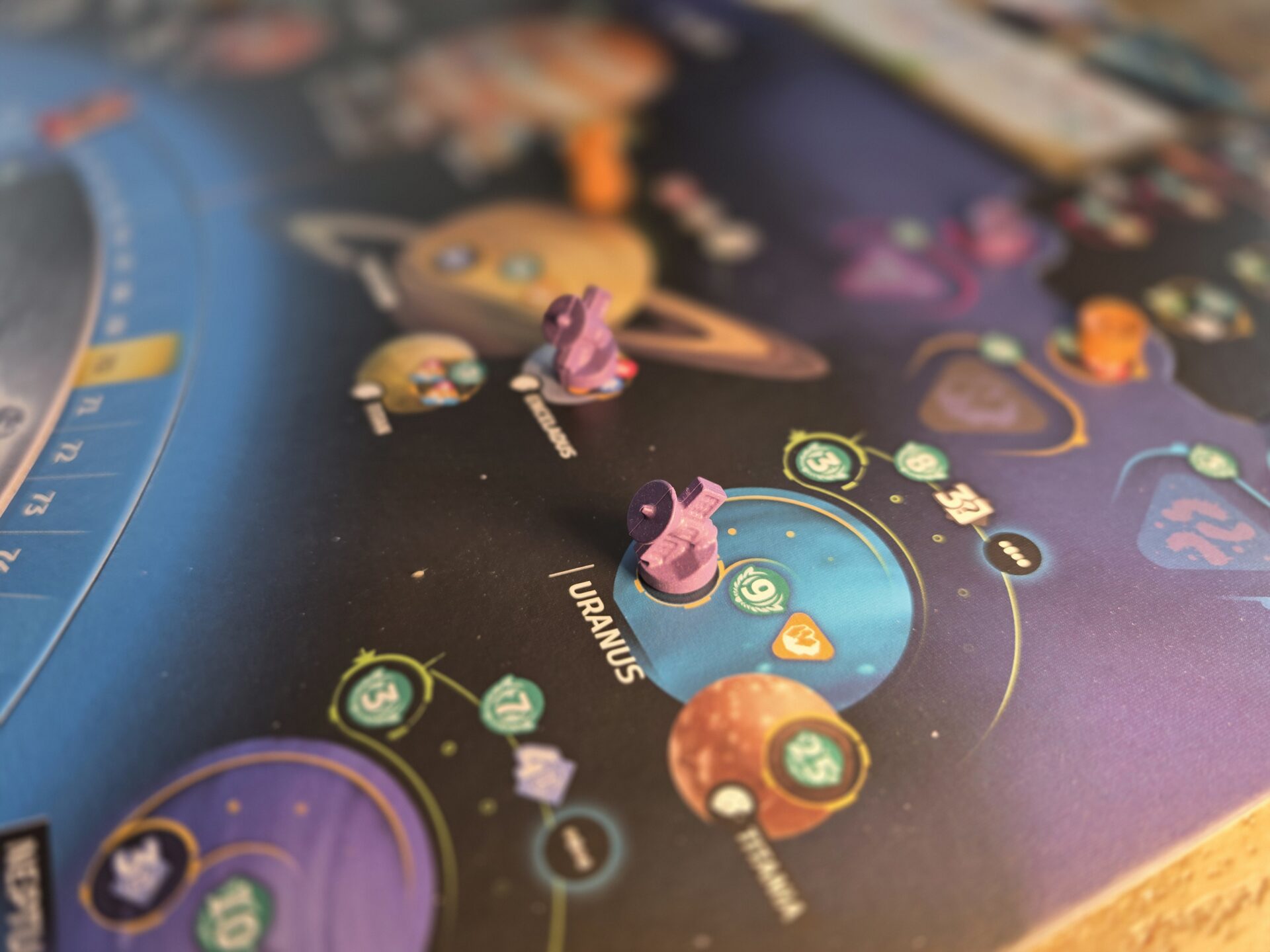
When a player has positioned their Probe onto a planet’s space on the Solar System Board, they have two additional actions they may choose to perform. The first is ORBIT, which typically costs one Credit and one Energy. When chosen, the player will move their Probe from the Solar System Board to the Planetary Board, placing their Probe in the orbit of the necessary planet. Orbiting is a great way for players to gain the ability to Tuck cards, meaning they are able to slide one of their unplayed cards beneath their Income Card, gaining the icon in the corner immediately as well as on every Income Phase going forward. Being the first Orbiter at a planet will earn the player a handful of Victory Points and even makes the LAND Action for that planet cheaper for everyone. Speaking of…
LAND On a Planet or Moon
Paying the default amount of three Energy turns your Probe into a Lander, allowing a player to move the figure from the Solar System Board to the Planetary Board. With improved technology, players can make this cost cheaper or even land their Probe on the planets’ Moons. Using the LAND Action is similar to ORBIT in that the player will gain multiple bonuses, as well as extra Victory Points for being the first Lander on a planet, but there is one key difference: discovering Life Traces, specifically a Yellow Life Trace. I’m going to touch more on Life Traces in a later section so just remember that the only way to grab the Yellow variety is to take the LAND Action.
SCAN Nearby Stars
Returning to activities on Earth, the SCAN Activity let’s players use telescopes to collect Data on nearby stars. When a player starts the game, the SCAN Activity gives them the ability to collect Data on two points of interest: any star in the current sector that Earth is in and a star in a sector matching one of the three cards in the Market. When the player has decided which star they want to SCAN, they will remove one of the Data Tokens from the cutout in that sector and replace it with one of their circular Player Markers. This Data Token is then either placed in one of their open Computer spaces or into their Data Pool, which can hold up to six Data Tokens.
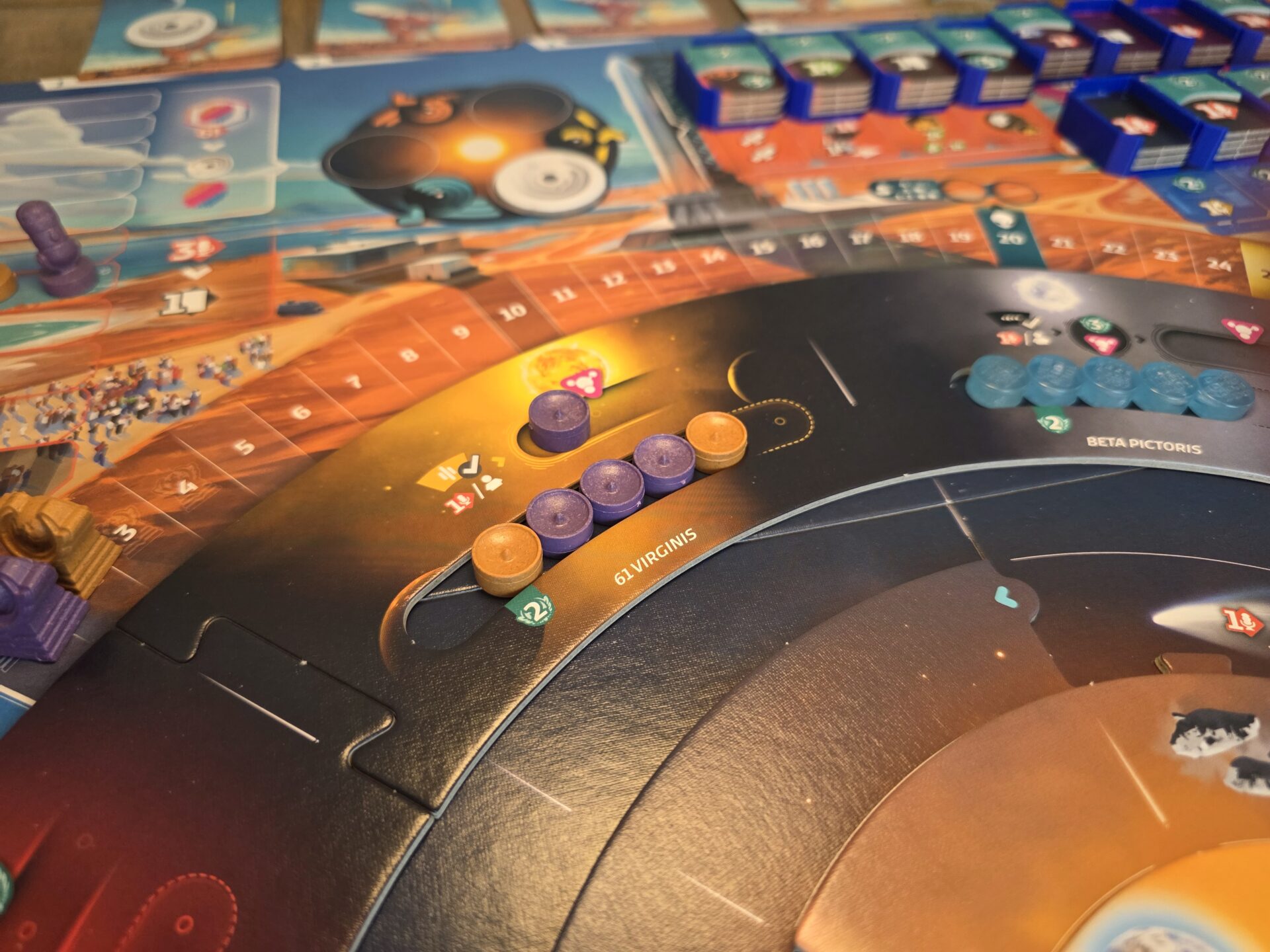
The goal with SCAN is to have the most markers in a sector once it is filled completely with Player Markers. At completion, the majority owner wins that sector, getting a variety of bonuses, typically including a Pink Life Trace. Sectors are filled back up with Data Tokens after they have been completed and resolved so numerous players can win future sectors but even those who contributed to the scanning of a sector get a complimentary reward so their help isn’t in vain.
Much like the LAUNCH/ORBIT/LAND Actions, Tech Tiles can severely boost the impact of a player’s SCAN ability. While these added abilities usually have a cost, they let the player improve the number of scans they are able to perform in a single turn or improve the option of sectors. One tile even allows players to combo up the LAUNCH Action with the SCAN Action to help gain some efficiencies.
ANALYZE Data.
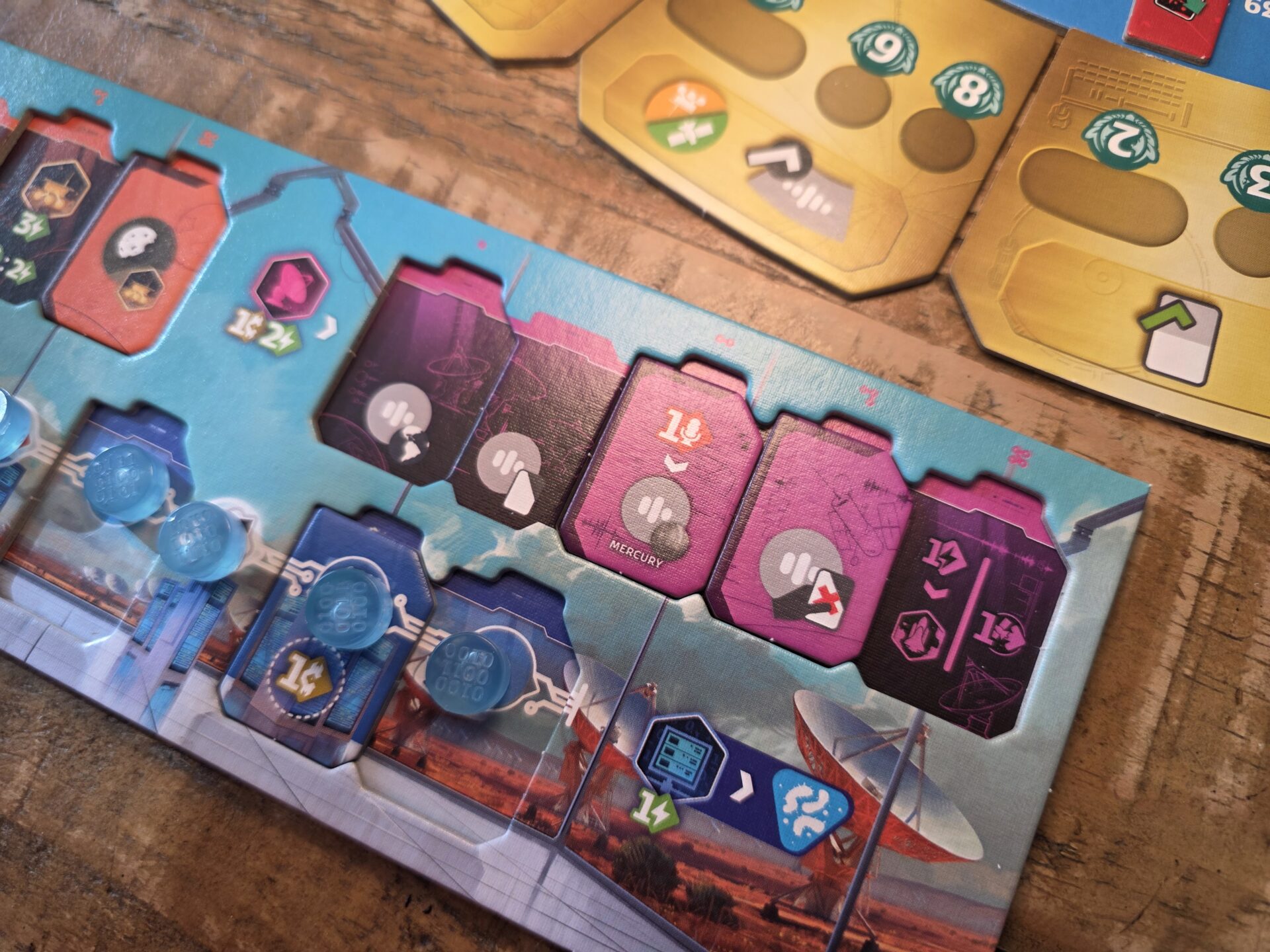
Remember those Data Tokens mentioned in the last section? Here is where they come into play. As players get Data Tokens, they can choose to place it directly into their Computer (a series of horizontal spaces running on the bottom of their Player Boards) or keep up to six in their Data Pool. Some of the Computer spaces have printed bonuses on them and the player gets these when they fill that particular spot but the main goal is to fill every Computer space. Once this is completed, players can take a turn to ANALYZE.
This action is much more straightforward than the ones previously discussed. When taking this action, the player pays one Energy, removes all of the Data Tokens from their Computer, putting them back into the supply, and immediately takes a Blue Life Trace. If there are any tokens in the Data Pool, they can now place these into empty spaces in the Computer. Much like the other Main Actions that reward Life Traces, this is the only way that players can obtain the Blue variety. There are also Tech Tiles that can improve the rewards you’ll get from placing Data into your Computer.
RESEARCH a Tech
I’ve mentioned the Tech Tiles a few times now so you’re probably wondering how you even obtain these elusive tiles. Players will want to use their Main Action to RESEARCH if they want to put their hands on these improvements. Players do have to spend six Publicity, a track we haven’t really talked about yet but you’ll be rewarded with Publicity as you take a variety of actions in the game. When you RESEARCH, you’ll decrease your Publicity Counter by six places, rotate the Solar System, and then pick out one of the Tech Tiles to add to your Player Board. The first player to grab any of the twelve different tiles will be rewarded with two bonus Victory Points, so try to grab these early.
PLAY a Card for its Effect
Players will be drawing cards throughout the game, using the PLAY Action to put these cards into effect. I waited to talk about this because the majority of cards are going to let players take the actions we’ve already talked about but at a cheaper price or modify these actions for improvement in some way. When playing these cards, the player will just resolve the effects and then discard the card, though they do have to make sure they can pay any necessary costs. Alternatively, there are cards that will remain in front of the player when played. These cards will involve Missions of which there are three types. The first type is a Conditional Mission. At any point during a player’s turn, if they have met the stated the conditions, they can Complete the Mission and gain the rewards. They can even Complete it immediately upon playing if they’ve previously met the condition.
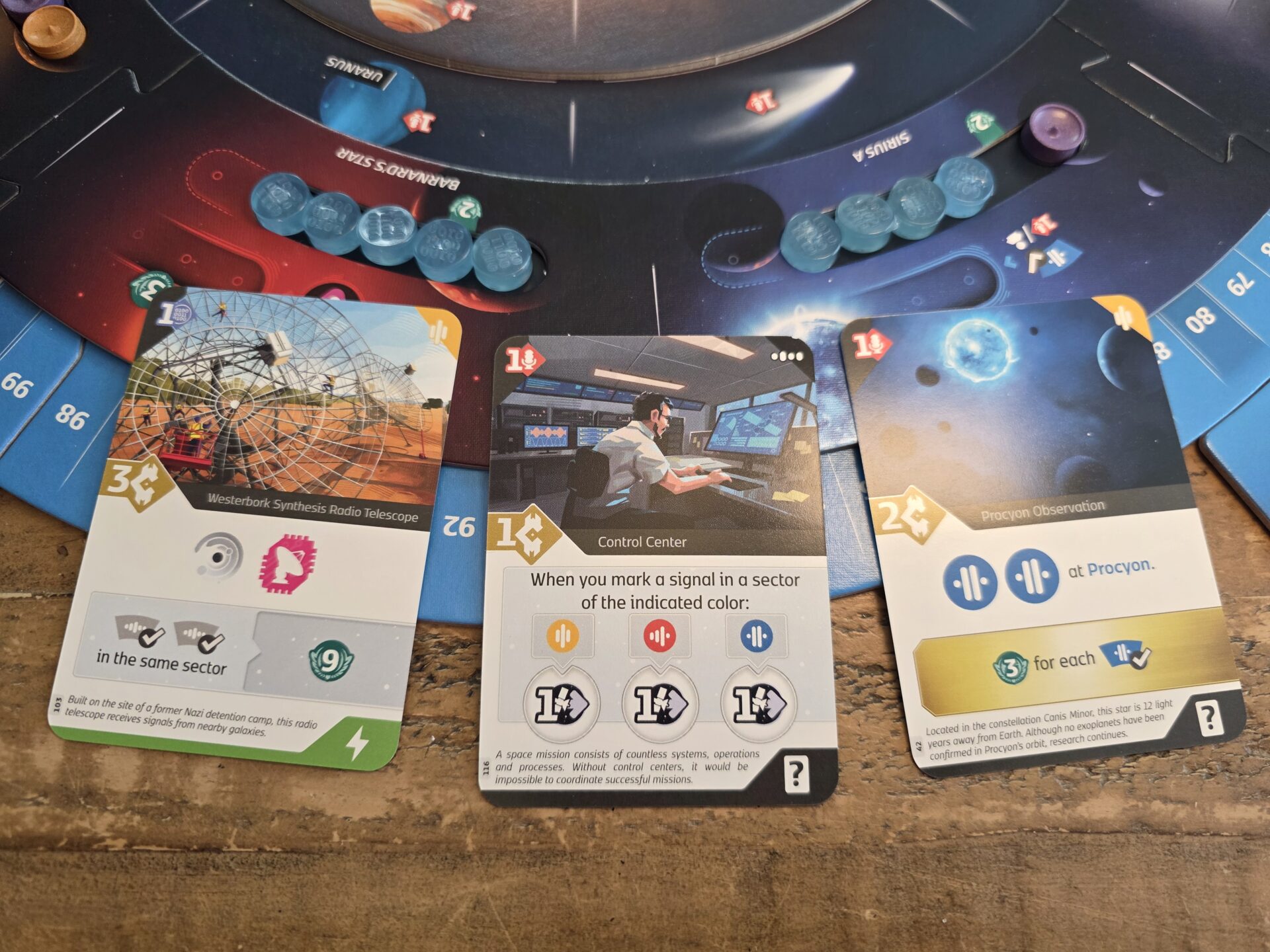
The second type of Mission is the Triggerable Mission. These cards let the player trigger an outcome when they do certain actions. This is different than the Conditional Missions as only actions taken after the card is played will count towards rewards. Many of the time, the Triggerable Missions will have multiple rewards that the player can choose from, allowing them to trigger the card a multitude of times.
Lastly, there are Mission Cards emblazoned with a Gold Banner, that add End-of-Game Scoring Opportunities.
PASS
The last Main Action one can take is the PASS Action. Players will typically choose to do this when they are out of resources, cards, or can’t take any further actions. Passing means that this player can no longer take any actions during the current round, though they do get to draw a card from the End-of-Round stack so the earlier they PASS, the better chance they can snag the card that they need. Once all players PASS, the round is over and everyone moves to the next round together.
Life Traces and Alien Boards
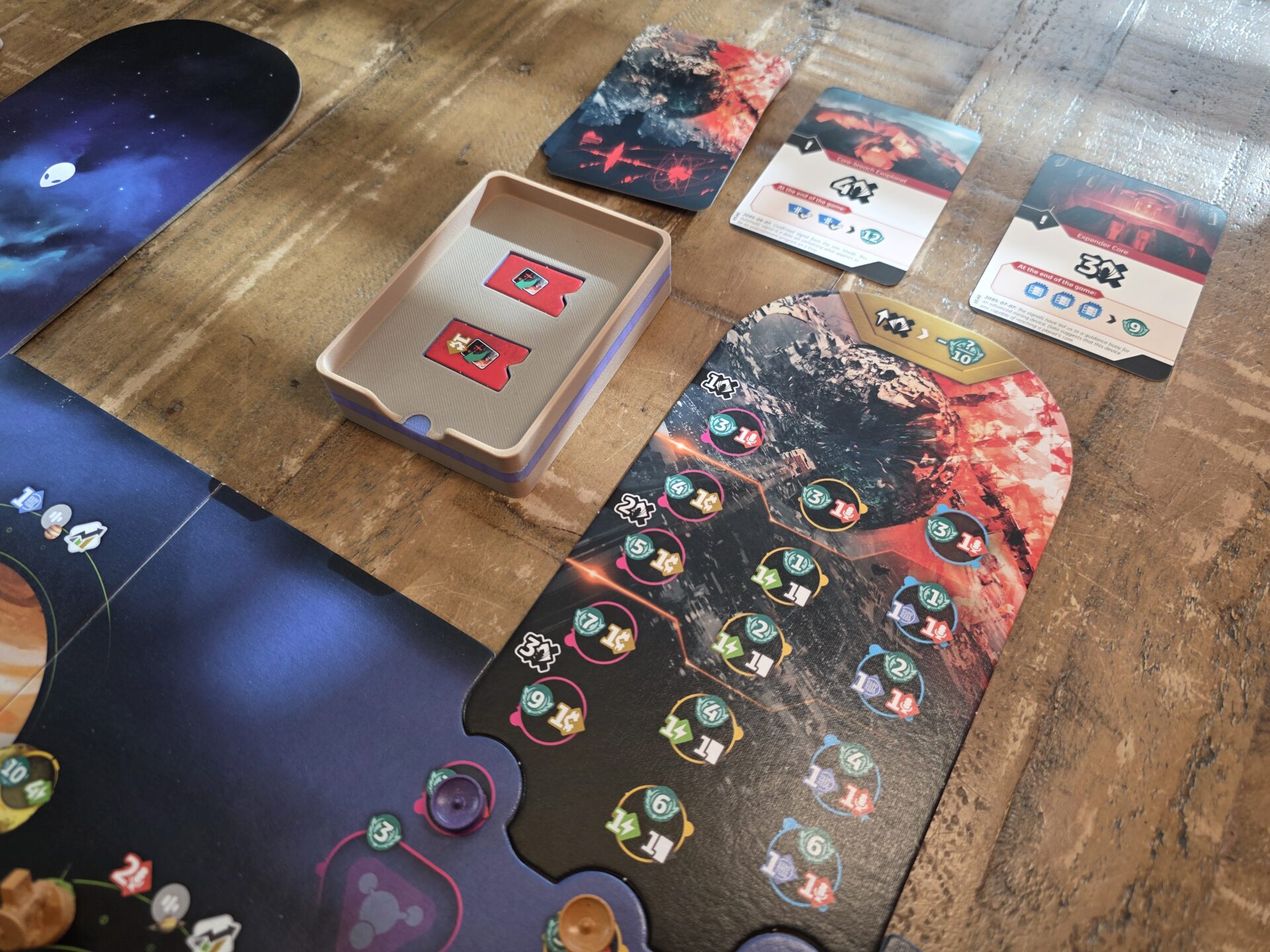
The flavor text across SETI’s cards and rulebook talk a lot about “discovery” so it was only apt that there be a discovery component to the game. Each game of SETI is played with two Alien Species, picked at random during setup. These boards and components are a mystery to the players until they have discovered enough Life Traces to bring the alien forth. When one of each of the colored Life Traces is marked by a Player Marker, that Alien Board is revealed at the end of the turn and any instructions for how to incorporate that Alien Species into the game is done at this point. Players who helped discover the species by marking a Life Trace usually gets some sort of bonus too. The Aliens all act differently, but most of them have tokens that will have different effects as well as a deck of cards unique to each Alien. Players can draw these cards, when instructed, and play them just like any other card for added interaction with the Alien Species.
End Game Goals
Each game also features four randomly drawn End Game Goals that are set out beside the board. These goals each have three different point values and display some sort of collection. When a player reaches or passes one of the gold spaces on the Victory Point Track, they are allowed to place a marker on one of the VP spots on the End Game Goals. At the completion of the game, they will score the points they covered with their marker for each of the collections they were able to make that match the goal tile. For example, one tile shows two Tech Tiles of any color. If player A marked the eight point VP spot, and ended the game with four Tech Tiles, they would be awarded 16 points (eight per collection).
Solo Variant
The game also comes packaged with a wonderful solo variant. The player’s turns play out exactly the same as in multiplayer which I love because I don’t have to remember another set of instructions. The bot is controlled with a deck of cards, slowly gaining more powerful cards as it takes actions, and even can introduce cards that will allow it to interact with the chosen Alien Species. The Solo Objectives are also a nice touch to bring something different to the solo game that isn’t found in the multiplayer version. I do a lot of solo gaming so I appreciate when a game can offer a fun variant, without a lot of upkeep and a variety of difficulty levels. SETI does all this perfectly.
Conclusion
I really can’t say enough good things about SETI: Search for Extraterrestrial Intelligence. It’s a euro game with a lot of moving parts but never feels overwhelming, thanks to only being able to do one main action per turn. I will warn you that a four-player game can feel over-long so you might want to keep it to three or below. Personally, I love the addition of the Alien Species to add some variety to each game. Depending on the species revealed, players might need to shift their strategies to benefit from the Aliens. Even the Solo Variant is a blast. If you’ve read this far, you are obviously at least slightly interested so do yourself a favor and just go buy the game!
Rating
Ratings are based on 5 main criteria: rulebook, setup, components, art & graphic design, and gameplay. The first 4 criteria are rated 1 to 5 and the gameplay is rated 1 to 10. These scores culminate in an “overall satisfaction” score that is rated from 1 to 10. If the reviewed game has both a solo and multiplayer mode, I have assigned scores separately to give context to which mode we enjoy more.

Rulebook – 4.5
Setup – 3.5
Components – 5
Art/Graphic Design – 4.5
Gameplay (Multiplayer) – 9
Gameplay (Solo) – 8
Overall Satisfaction (Multiplayer)
Overall Satisfaction (Solo)
Pros:
- Top-notch components that make a statement on the table
- Many actions to perform without feeling overwhelming
- Great implementation of a solo variant
Cons:
- Players need a lot of table space
- Sector Boards slip and slide around when handling Data Tokens
Links