
Name: KING
Year of Release: 2026
Player Count: 1 – 3
Playing Time: 30 – 60 Minutes
Designer: Radosław Ignatów
Publisher: Self-Published
Primary Mechanisms: Paper-and-Pencil, Tech Trees, Solo
Overview
In the interest of transparency, I received a complimentary copy of KING for review purposes. This did not influence my assessment, and the opinions expressed here are my honest and unbiased reflections on the game.
At the time of this writing, the solo mode was the only version available. This review may be updated in the future when the multiplayer version is released.
One thing that keeps me in the board gaming hobby is the sheer amount of creativity displayed by designers, artists, publishers, and all others who help bring a board game to life. Sure, a lot of games aren’t re-inventing the mechanism wheel but being able to see how these same mechanics are implemented in creative ways is just… well, fun! And with the rise in popularity of crowd-sourced sites, the ability for even a single person to bring their vision to life has been made a reality. Which brings us to KING.
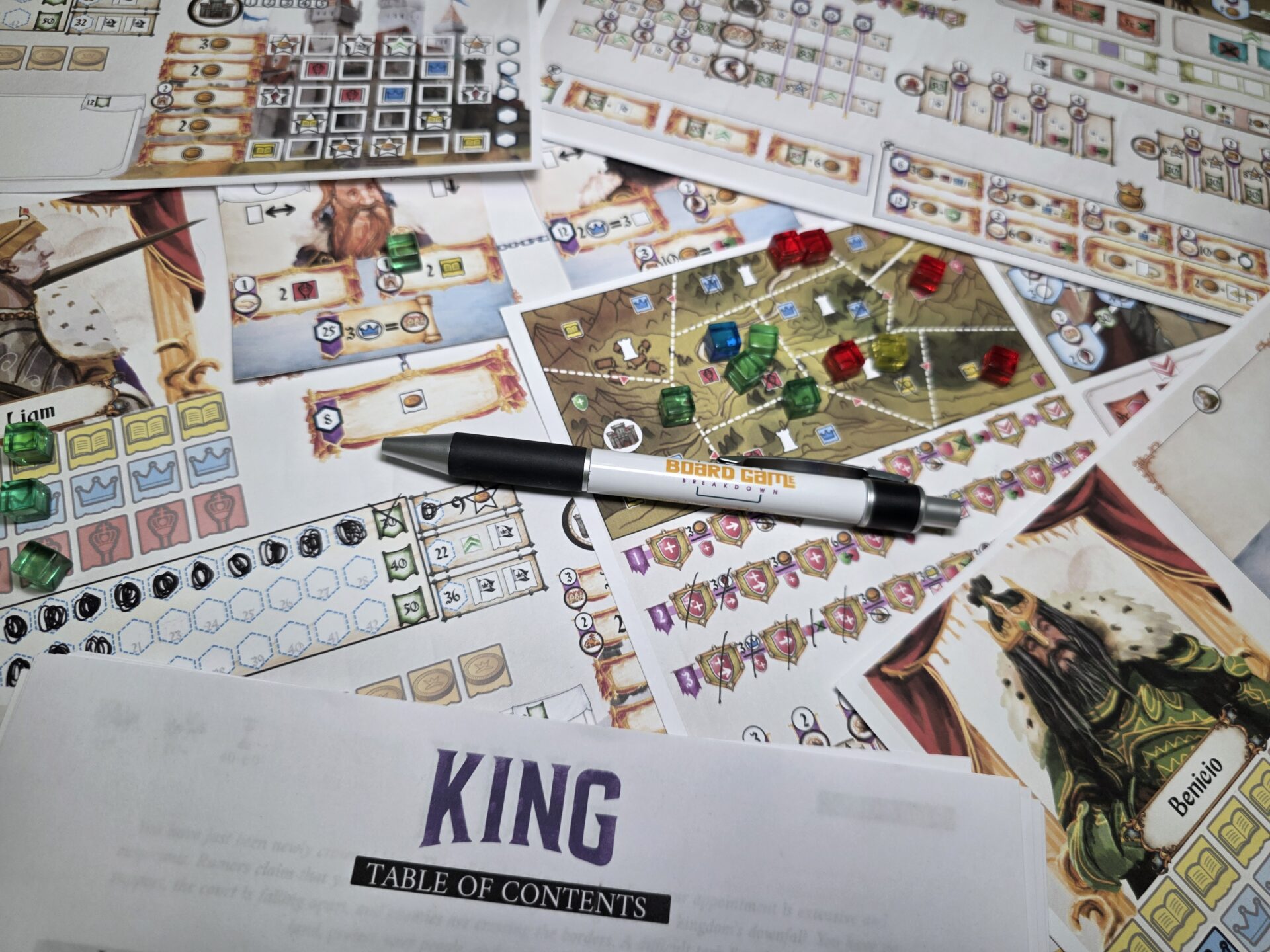
KING is a print-and-play game created by Radosław Ignatów. It is billed as a sequel to his game KNIGHT, but don’t worry, you won’t need to have played KNIGHT to enjoy KING. This latest creation takes hints from “flip-and-write” games such as Hadrian’s Wall or The Anarchy but holds its own space in the gaming landscape with a few key elements. Unlike some of my other write-ups, I’m not going to go into every detail of how to play KING. Honestly, Ignatów created a really thorough “How to Play” video that will explain it better than I ever could, so why try? However, I will touch on what I really enjoyed about KING, as well as a few things that I believe could have made it even better.
If you’re reading this before March 16th, head over to the Kickstarter to get your pledge in. If not, there will be a chance for late pledges and also check out Ignatów’s store, where KING will be available soon.
Event Cards
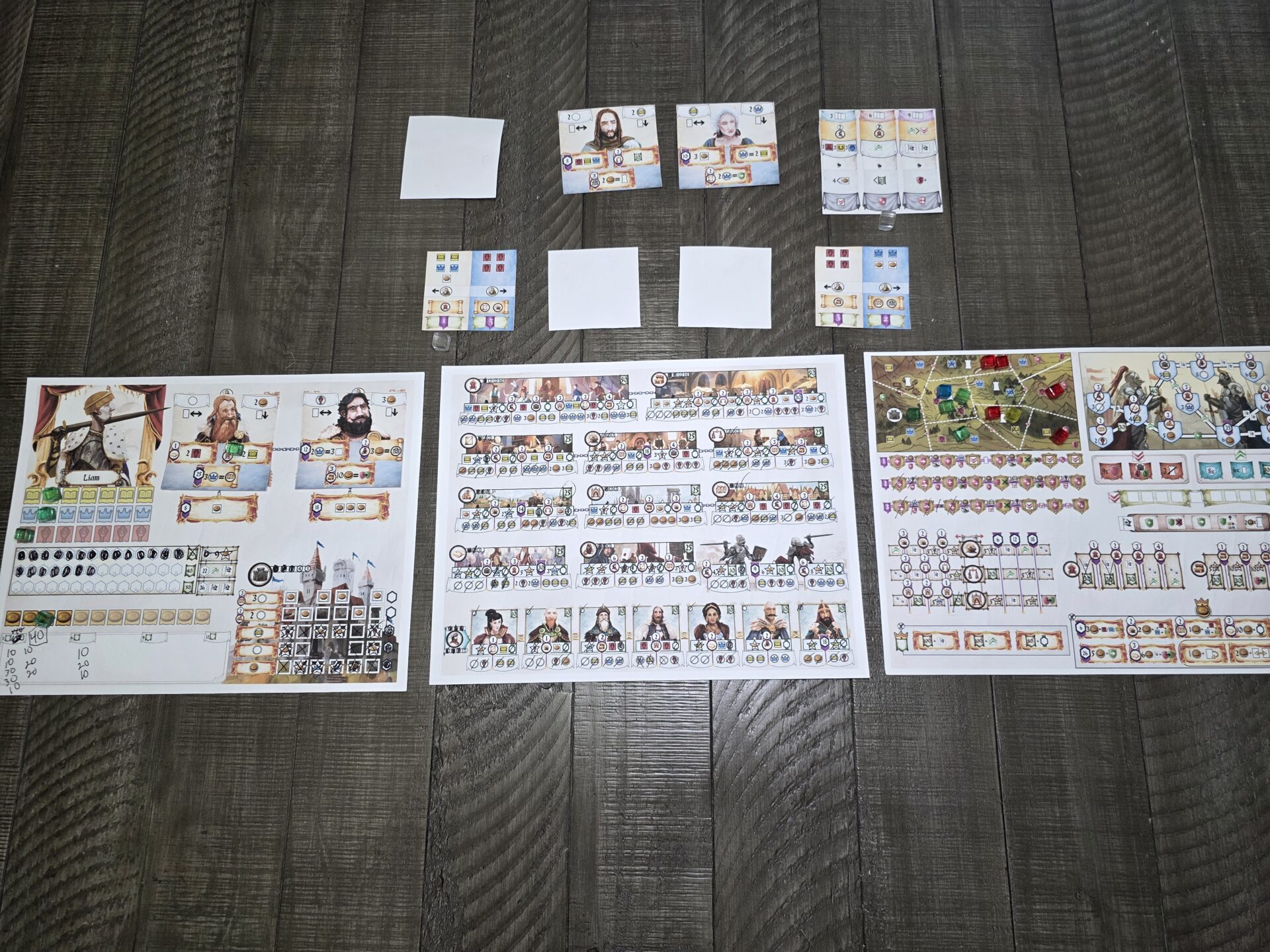
In KING, the Event Cards are going to be the vehicle for the bulk of your decision making on any given turn. These cards are a wellspring of information, and the game uses them in a mixture of both public and hidden formats. At the start of the first, fourth, seventh, and tenth rounds, four cards will be placed in a row, with only the first and last ones being turned face-up. When a round starts, the furthest left card in the row will become the Active Event Card the player will be utilizing that round. So, what’s on the Event Card themselves?
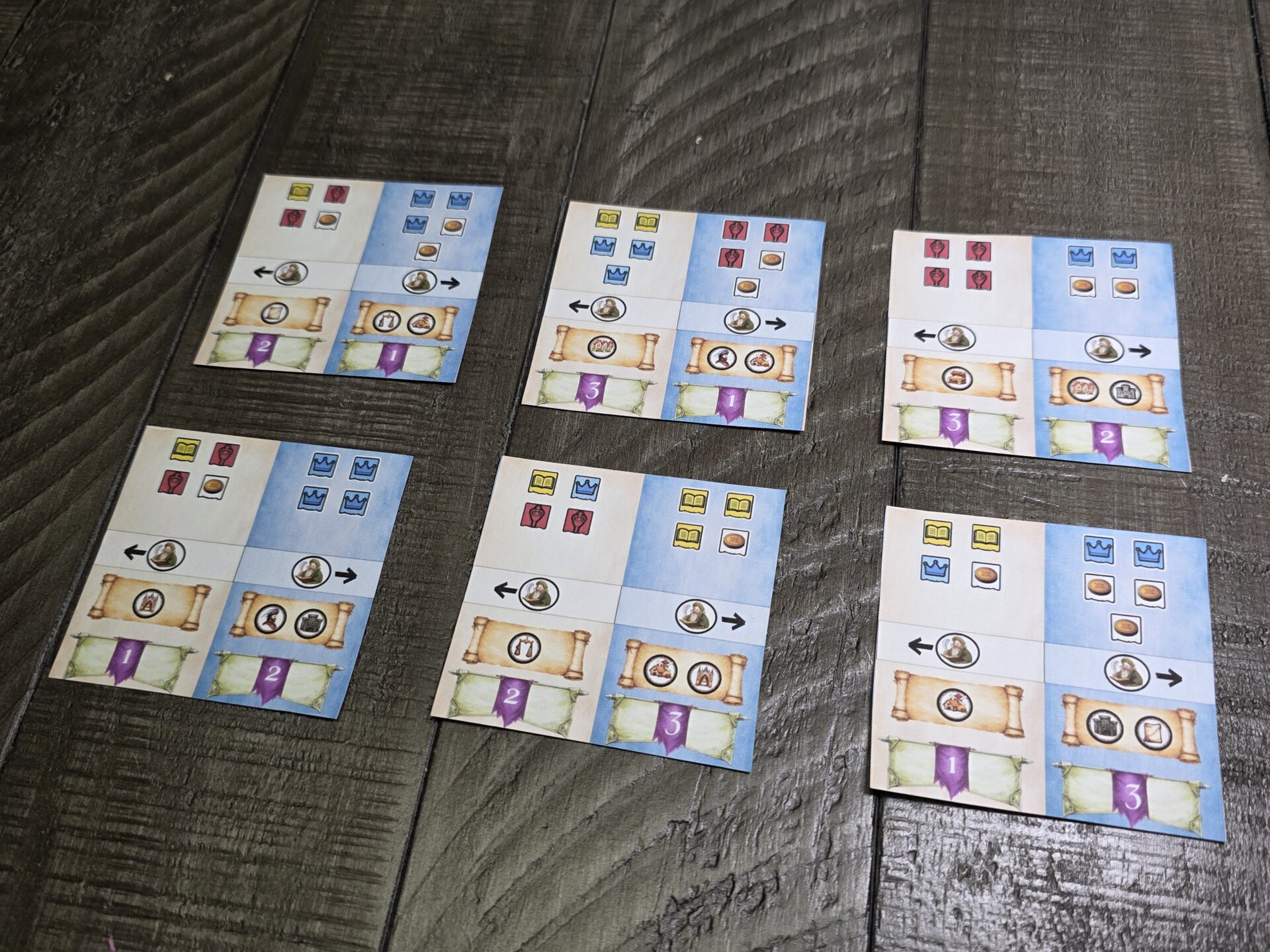
An Event Card can be thought of being two columns of four rows each. At the start of a round, the player must choose to trigger the left or right column. Once this decision is made, the player will work their way down through the four rows, taking part in each of the actions listed. These actions include:
- Gaining Resources on your King Card
- Activating the Advisor placed on the same side equal to the column the player chose.
- Activating the Domain(s) listed in the scroll icon.
- Lastly, resolve the next Consequence in row matching the number listed.
With this workflow in place, players can strategize from the very beginning of the round, what they are going to be capable of doing, even so far as knowing the Consequence that they will have to face at the end of the round. You’ll remember though that the second and third Event Cards are face-down, so even though they will be flipped with those rounds start, the player can only plan so far in advance. Then there is that fourth card that is face-up, which will eventually get moved to the front of the row (in the fourth round) and be used then.
I’ve really liked this idea of having full information at the beginning of a round but not really knowing what’s past there. KING even gives you a chance to spend Coins to flip Event Cards over or swap their places to allow you a little more control over outcomes. With this upfront information though, one can become mired in Analysis Paralysis by trying to work out all combinations of moves before then even gain the first resource, so watch out for that.
Advisors
The aforementioned Event Cards allow you to trigger one of the Advisor Cards located on your King Board. Your first two Advisors are randomly selected at the beginning of the game, but more will become available as you progress, allowing you to pay a cost to swap them in and out. The Advisors function in a dynamic way, making the actual placement of the Advisor as important, or even more important in some cases, than which Advisor to use. This is all brought to life through the chaining mechanism between the two Advisor Cards.
When the left or right side of the Event Card is chosen, that is going to dictate which Advisor Card (the one in the left space or the one in the right space) you can activate. On each Advisor Card there are three Action Spaces: one located at 3:00, one at 6:00, and one at 9:00 if looking at the face of a clock. At some point in your turn, one, and only one, of these actions can be taken. The twist is that your left Advisor’s 3:00 space is chained to your right Advisor’s 9:00 space. This means if you chose the left side of the Event Card, you could activate both the left side’s 3:00 space first, and then the right side’s 9:00 space second. This is also true for the Advisor’s 6:00 space, though these are chained to pre-printed actions on the King Card itself.
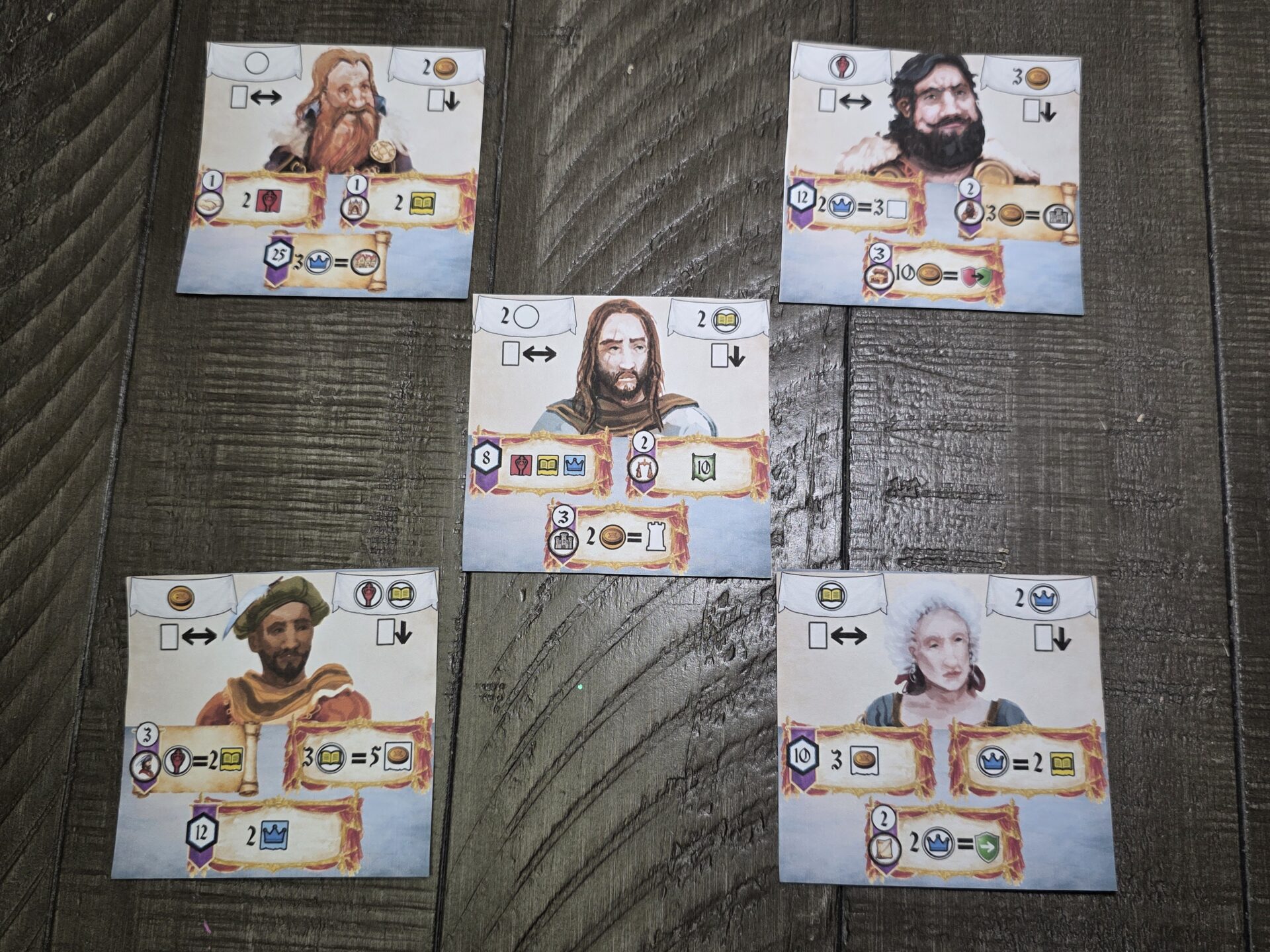
This is a really smart concept and is so important that it can truly impact on which side of the Event Card to use. Much like how one can pay to influence the Event Card order, players will find certain times when paying to swap out one Advisor with another is the smart play. Especially if this move allows you to chain together two perfectly timed actions; the satisfaction is real. My one gripe is that too many Advisor Actions are gated by too high requirements. A lot of the time, it doesn’t feel that I can utilize my Advisors in the early game as much as I’d want. Maybe this would unbalance the game, but I’d still like to see the Advisors used for more than just grabbing a few extra Resources in the early game. Speaking of gating…
The Ups-and-Downs of the Kingdom Card
The majority of the player’s penmanship is going to be spent on the Kingdom Card. This central card holds the 12 Domains that will represent the development of your Kingdom throughout the game. Most of these Domains are split into a varied number (though most are four) of horizontal sections, which I’ll call Levels. Between these Levels there are Requirement Thresholds printed. These typically call out other Domains and how far along you need to have them developed, but some just require the player to have a base amount of Influence Points on their King Card. Players will be spending Resources on these tracks, filling in spaces from left to right, meeting the Requirement Thresholds, and getting more and more rewards as they go on.
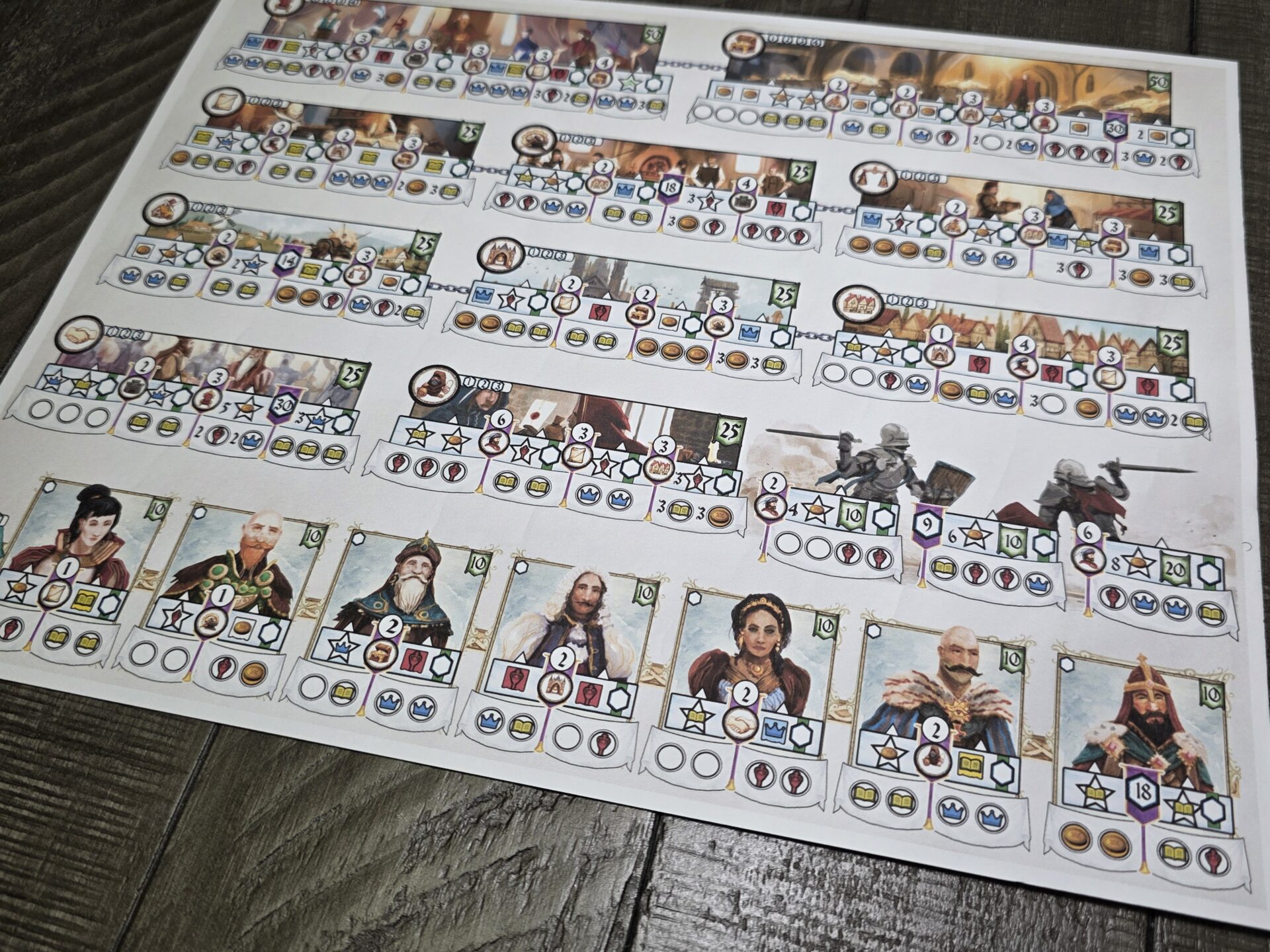
Some of the Domains are even chained together, meaning that when one is completed, activating it can cascade into the chained Domain, making way for even more combos on a single turn. Even without the chains, the Domains (through the Requirement Thresholds) are all interwoven, almost giving the player the sense of a Rubic’s Cube when developing. A player might really want to get to level two of The Church, but that relies on them having level two of the Scholarship track, and that’s gated behind the influence of a second Lord. Figuring out the most efficient way to unlock these interwoven strands is a real thrill when it all comes to fruition.
But this can be a double-edged sword. The Domains are so interlocked, I almost feel like I’m having to follow a prescribed path while playing. I’ve seen this most with Domains tied to both the Cities and the Villages Domains. Both of these take a lot of work to even reach the second Influence space, but without gaining this space, many of the Domains are locked up behind the first few Levels. I think this could easily be remedied by having a number of the gates be an “either/or” situation. Maybe you can’t get to the second level of the Treasury without getting to the second level of something, but it doesn’t have to only be the Villages Domain. Maybe players could have a choice between the Villages and the Craftsmanship Domains? I believe this small tweak could open up the Kingdom Card to more player agency and solve this problem, which I see as the biggest problem with the game itself.
Scenario Map
Right up front, players should be aware that KING is not for the faint of heart. It is going to be a difficult ride to meet the winning achievements, no matter which scenario you play in. The difficulty comes from managing the Scenario Map where your Units will be battling Enemy Units, in an effort to protect your Castle. This is made difficult because the enemy hordes are going to grow, and move, faster than your troops since the majority of Consequences at end-round are going to work towards their advantage. On your side, you will have to wait until you earn Command Points to influence the battlefield. These Command Points allow players to add additional Units, move Units, attack Enemy Units, and even build fortified Towers, amongst other things.
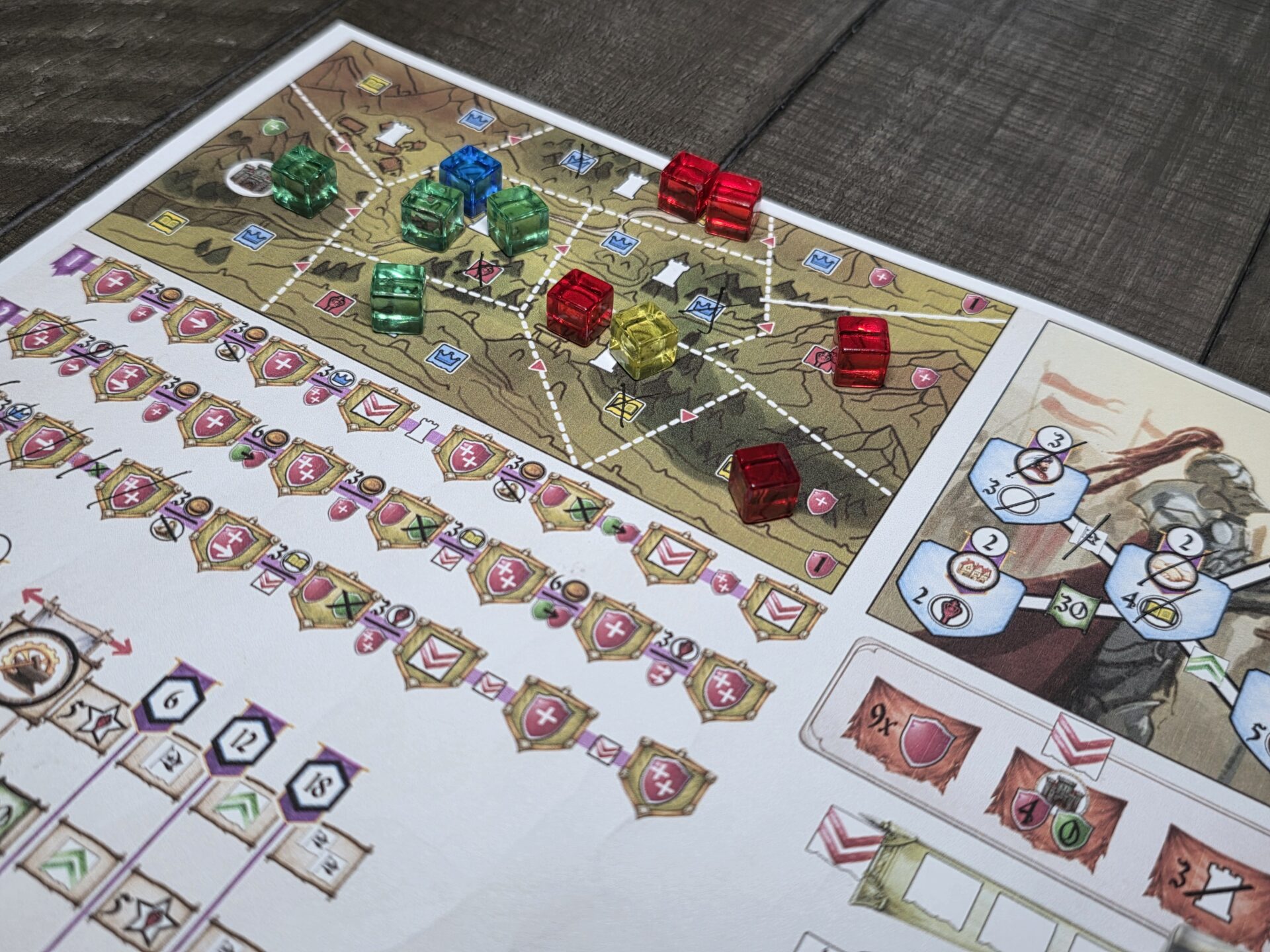
While I like the use of Command Points, gaining them does feel disconnected from a lot of the work being done on the Kingdom Card. Numerous times I found myself being really proud of what I accomplished on the Kingdom Card within a given turn, only to be disappointed because it didn’t end in me gaining any Command Points, thus ceding even more space to the Enemy Units on the map. For a game that operates with so many interlocking systems, Command Points feel a little bit on an island by themselves.
Conclusion
While I have fallen short of getting a win in KING, it is a testament to how fun the game is that I continue to come back to it again and again. Each time I play it, I’m excited to see if I can unlock the secrets and finally best the Enemy. Yes, there are a few minor changes that would benefit the game overall, but I also admit that said changes could make the game too easy. I am by no means a game designer, so I trust the people who know what they’re doing, such as Ignatów, to make the best decisions for their projects.
For fans of Hadrian’s Wall or The Anarchy, or folks looking for a more economical game that still has layers and layers of substance, I highly recommend KING.
Rating
Ratings are based on 5 main criteria: rulebook, setup, components, art & graphic design, and gameplay. The first 4 criteria are rated 1 to 5 and the gameplay is rated 1 to 10. These scores culminate in an “overall satisfaction” score that is rated from 1 to 10. If the reviewed game has both a solo and multiplayer mode, I have assigned scores separately to give context to which mode we enjoy more.

Rulebook – 3.5
Setup – 4.5
Components – 3.5
Art/Graphic Design – 4
Gameplay (Solo) – 7
Overall Satisfaction (Solo)
Pros:
- Implementation of Advisor Cards and Event Cards
- Chaining mechanism for Advisors and Domains
- Deep gameplay at an economical price point
Cons:
- Requirement Thresholds can be harsh, limiting autonomy of player decisions.
- Command Point implementation feels disconnected from play on Kingdom Card
Links
Kickstarter: KING on Kickstarter